When Parents Go Silent: Can the Silent Treatment Hurt More Than Scolding?

For days now, your mom has been reading your messages in the family group chat and not replying.
It started last month, when you told your parents you’d be out with friends that weekend and wouldn’t be home for dinner. She didn’t yell. She just said “Oh,” and then stopped talking to you. The next weekend you went home to eat, and she laughed and chatted with everyone else at the table without once looking at you. Anything she needed you to know came through your dad. After dinner you stood outside her bedroom door for a long time, ready to apologize, except you weren’t sure what you had done wrong. One question kept going around in your head: “She didn’t even yell at me, so why does this feel worse than being yelled at?”
You’re an adult with a life of your own, and still you haven’t been able to put her silence out of your mind for days. Every spare moment, you open the chat to see whether she’s replied. You also know it will most likely end the way it has before: you’ll be the one who messages first to say sorry, and only then will anyone at home start talking to you again.
What the silent treatment looks like in a family
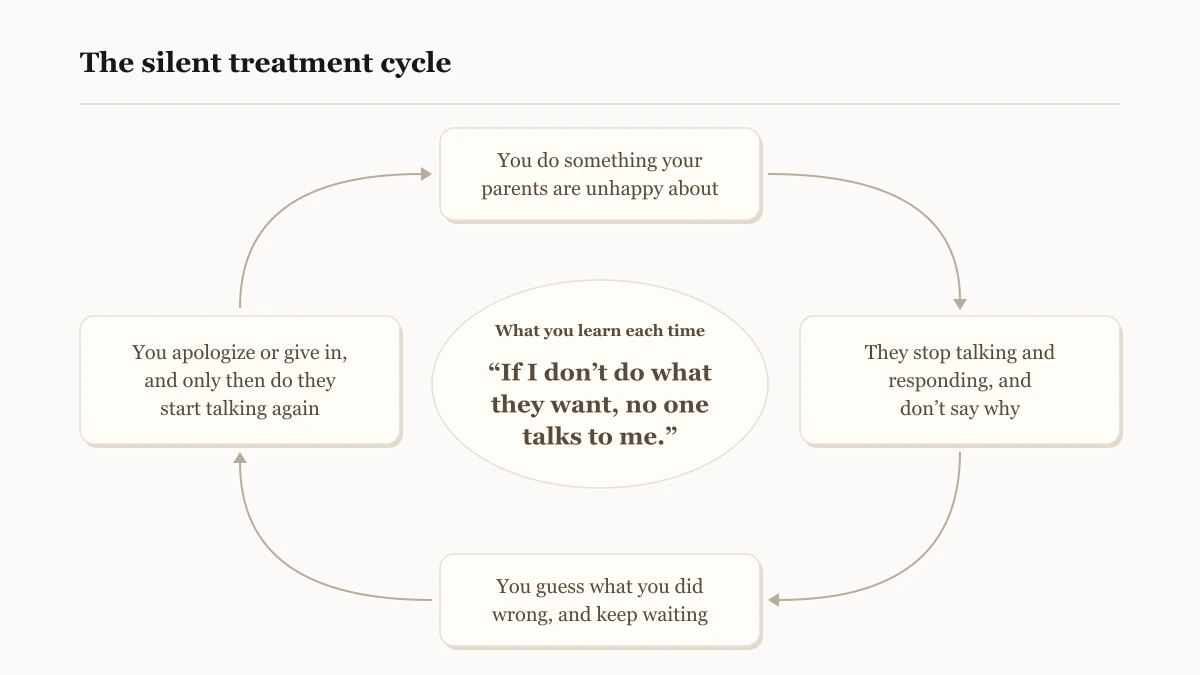
In a family, the silent treatment is when your parents are unhappy with you and, instead of saying so, they stop talking to you, stop answering you, and won’t even look at you. The everyday care they usually show you stops too. That is how they let you know they’re upset. They don’t say what they’re upset about. They don’t say how long it will last. Often things only go back to normal after you apologize or do what they wanted. It is the family version of what people call emotional coldness, and psychology puts it in a category of behavior known as love withdrawal.
At home it tends to look quiet. Dinner still gets made, but your name gets no reply. Everyone else at the table laughs and chats, and the conversation goes silent when it reaches you. If there is something you need to know, another family member passes it along. If you try to start a conversation, you get one word back before they walk away. None of these things looks like much on its own, which is why, from the outside, nothing seems wrong in that house.
Two misunderstandings tend to come up. The first is “Nobody yelled at you, so you weren’t hurt.” That isn’t how it works. The absence of harsh words doesn’t mean you came through unharmed; it only means the hurt made no sound. The second is “The silence gives you time to think about what you did.” During those days, you may not be thinking about what exactly you did wrong. You may be wondering whether your parents will ever talk to you again.
Parents also get tired, of course, and sometimes need some quiet. To tell which it is, there are three things to look for: whether they say something before going quiet, like “I’m really tired, let’s talk later”; whether, after a while, they come back and start talking to you on their own; and whether, when they do, you have to admit you were wrong first. If they said something first, came back on their own, and didn’t need you to admit anything, it’s more likely they were just tired. The silent treatment is the opposite on all three.
Does a parent’s silent treatment hurt more than scolding?
As I see it, often yes, because when you get scolded you at least know what happened, while silence leaves you alone to work everything out by yourself. That doesn’t make scolding the better option. Loud scolding and harsh words leave their own marks. But the two hurt in different ways, and the kind silence leaves behind is often harder to put into words.
You don’t know what you did wrong, so you start doubting everything
Silence won’t tell you whether this is about a decision you made, not coming home for a while, or something you said on the phone. So you search on your own, going through everything you’ve done lately: your tone on your last visit home, a reply in the group chat that came out too short, something you said on a call last week. Any of them could be the reason. Since you can’t pin down the real one, you treat all of them as your fault. And the guessing doesn’t happen once. Every time you open the group chat, it starts over.
You don’t know when it will end, so you’re always the one who gives in
Silence has no agreed end date. It might last one evening or a whole week. All you can do is keep watching your parents’ tone and messages and hope today will be a little better. When you can’t take it any longer, the most common way it ends is that you go and apologize, even if, to the very end, you never find out what the apology was for. An ending like that doesn’t actually talk anything through. It just gets people talking again, and the question you wanted to ask your parents, which was what you did wrong in the first place, never gets answered.
What gets taken away is care, and you learn: if I don’t do what they want, no one talks to me
Scolding is usually aimed at something you did. Silence takes away the ordinary care instead: asking whether you’ve eaten, reminding you to wear something warmer when it’s cold, listening to you talk about your week. All of that stops at once. Your parents’ care used to always be there, and now it shows up or disappears depending on whether you did what they wanted. Over time, you may start to feel that care has to be paid for with obedience. Go along with them, and they talk to you. Don’t, and you don’t even get a sentence. After enough of this, how you feel about yourself may start to rise and fall with other people’s reactions, and you may carry a resentment toward your parents that you can’t quite say out loud.
No noise and no marks, so even you wonder if you’re making too much of it
Silence leaves nothing behind. There were no harsh words and no shouting match. When you want to tell someone about it, you don’t know where to begin, because your parents really didn’t scold you or say anything cruel. And if you do tell someone, you might hear, “They didn’t even yell at you. What are you upset about?” This may be the hardest part of it: it hurts, and then it makes you feel you have no right to be hurt.
This silence may also shape how you get along with others
If this kind of silence has been part of your family for years, you may have picked up some habits without noticing, and carried them with you ever since. In your life today, those habits could look like this.
When someone near you goes quiet, you check yourself for mistakes first
Someone around you gets quiet. It might be a coworker whose replies get shorter, a friend who barely talks over dinner, or a family member who wants to be alone after work. Your first thought is “Did I do something to upset them?” You start replaying everything you said, trying to work out which thing you said made things go cold. So by the time it turns out they were just tired, you’ve already apologized several times in your head.
When you disagree, you’d rather apologize and move on
When your view differs from someone else’s, you may say “Fine, my fault” before you’ve even finished explaining yourself. Rather than make yourself clear, you’d sooner avoid the risk of the other person never talking to you again, because you know how bad it feels to be shut out. Over time, the opinions you never voiced pile up, and people assume you don’t have any.
When you’re the one who’s angry, you go quiet too
This one often gets noticed last. When you’re angry, you go quiet as well. It might be with a partner, a friend, or your own child: you don’t say what bothered you, and you leave them to figure it out. Then one day you realize that the way your parents shut you out, the thing you least wanted to go through again, is something you now do yourself, because silence is the only way of being angry you ever saw.
What you can do now
My suggestion is to replace these habits with new ones, one at a time. They took years to form, so it’s alright if changing them takes a while too.
When someone goes quiet, ask before you check yourself
Next time someone around you goes quiet and you catch yourself replaying everything you said, remind yourself that a person saying less isn’t necessarily a sign you said the wrong thing. Then just ask:
You’re quiet today. Are you tired, or did I do something that bothered you?
If they say they’re only tired, let them rest. You don’t need to keep asking, and you don’t need to keep hunting for reasons in your head. If they tell you what bothered them, talk about that specific thing: apologize for the part you got wrong, and say what you think about the rest. The biggest benefit of asking is that you no longer have to guess alone. You get the answer from the person who has it.
When your parents still go silent on you
Parents may do this because it’s how they were treated as kids, or because when they’re angry, they don’t know any other way to get the words out. Those struggles may well be real. But understanding your parents’ struggles doesn’t mean the hurt you’ve carried all these years doesn’t count.
Find a time when nobody else in the family is around and say it to your parent directly, using whatever you usually call them:
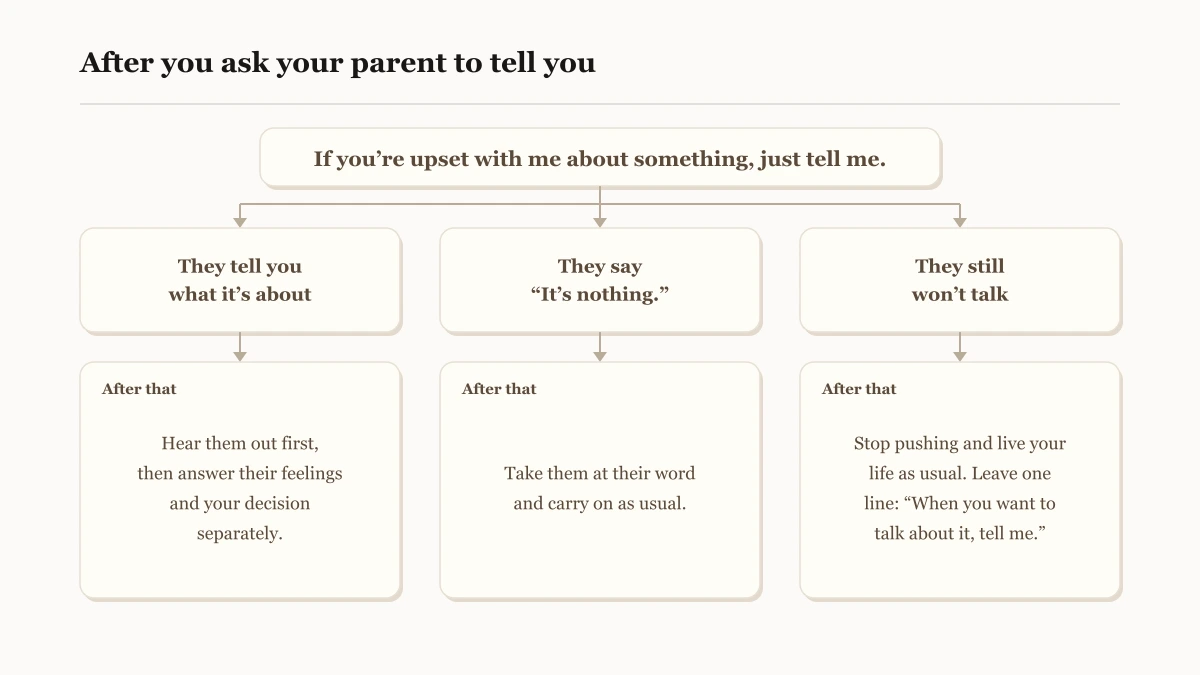
Mom, you haven’t talked to me for days. If you’re upset with me about something, just tell me.
Once it’s said, your parent will probably respond in one of three ways. If they tell you what it’s about, something like “You can’t even come home for dinner on weekends anymore,” let them finish before you explain anything. Then answer their feelings and your decision separately: “I hear that you feel I don’t care about the family. That day I’d made plans with friends a while back, and next time something like that comes up, I’ll tell you sooner.” You can respond to what upset them, but you don’t have to undo your own decision just because they stopped talking to you.
If they say “It’s nothing,” take them at their word: talk to them and spend time with them as usual, without checking over and over whether they’re still upset. And if they still won’t talk, stop pushing. Keep saying hello, keep living your own life, and don’t apologize for something even they can’t name. Leave them with one line: “When you want to talk about it, tell me.”
When you’re angry, say so
If you notice that you also go quiet when you’re angry, try saying this first instead:
I’m really angry right now and I don’t want to talk yet. Let’s talk tonight.
Then, when evening comes, actually go back and talk about what made you angry. That one sentence tells the other person three things: you’re angry, you need a little time, and you’ll come back to talk tonight. They don’t have to guess, and you don’t have to stew alone. It may also be the sentence you most wanted to hear from your mom while you stood outside her bedroom door.
Silence looks gentler than scolding, but it leaves you with more to carry
A lot of people think that not yelling and not arguing is the gentler way to be angry. But silence actually leaves you with more to deal with than scolding does. When parents scold, they are the ones putting their displeasure into words, and once the words are out, it stops. Silence hands the job of dealing with their displeasure over to you. You have to work out what they’re angry about, decide on your own when to go and apologize, and in the end talk yourself into believing it’s nothing to be upset about. None of that comes with an agreed ending, so the next time the house goes quiet, you start all over again.
Someone in a family being unhappy is ordinary, and your parents will have opinions about your choices. What lets a family get along after someone gets angry may not be that nobody ever gets angry. It may be that the angry person is willing to say it out loud: what it’s about, what they’d like you to do, and when it counts as over. Without those few sentences, however quiet a home is, things are only fine on the surface.
The next time the group chat stalls on “read” and you start wondering again whether you did something wrong, you can hold on to one thing: what goes missing during those silent days is a few plain sentences about what they’re angry about and what they want from you, and saying them is up to the person who is upset, not to you, the one left guessing. Remembering it won’t make your parents start talking any sooner, but it can mean you stop counting every silence as your own fault.
Sources
Research and sources this essay draws on.
- The Emotional Costs of Parents’ Conditional Regard: A Self-Determination Theory AnalysisJournal of Personality, 72(1), 47–88
- The emotional and academic consequences of parental conditional regard: Comparing conditional positive regard, conditional negative regard, and autonomy support as parenting practicesDevelopmental Psychology, 45(4), 1119–1142
- Longitudinal Links Between Fathers’ and Mothers’ Harsh Verbal Discipline and Adolescents’ Conduct Problems and Depressive SymptomsChild Development, 85(3), 908–923