My Partner Cheated. Should I Stay for the Kids?

You have lost count of how many times you have read them.
The kids are asleep. You sit in the dark living room, scrolling through the messages one more time, as if you might have misread them. Maybe it was not messages at all — a receipt that should not exist, a confession, a friend who took too long to answer “how are you two doing?” Whatever it was, since that night your life has run on two levels. The upper level keeps moving: work, dinner, the school bag by the door. The lower level burns all night.
In the morning, your child asks something completely ordinary — who is picking me up, where are my socks. You answer in your everyday voice. And in that second, the question surfaces:
Should I stay for the kids?
If that sentence brought you here, let me be clear about what this piece is. I will not tell you to stay, and I will not tell you to leave. People around you are probably already saying both, and none of them have to wake up in your life. You may even have searched this question in the middle of the night and found the answers split into two shouting camps — half telling you to wake up, half telling you to hold on — and closed the tab more tired than before. What I want to do is take “for the kids” apart — because that phrase is carrying the heaviest thing you own right now, and it deserves better than to burn in your head all night and still be just four words.
The person who thinks of the kids first
Let me start with something I genuinely believe: in the worst moment of your life, your first thought was your child. That fact alone says a great deal about the kind of parent you are.
What you are doing is what parents do every day — putting someone else’s life ahead of your own. There is nothing wrong with that instinct. It is just carrying extra weight right now, because you are being two people at once. One is the partner who was just betrayed — the one who wants to shake them awake at midnight and demand every detail, since when, and why. The other is the parent trying to shield a child — the one who turns the volume down at breakfast and keeps the grown-up things out of the child’s world. Both of them are really you, and what they want seems, tonight, to be at war. If you have been flipping between decisions by the hour — leaving at midnight, wavering at the sight of a sleeping face — that is not confusion. That is two things you love being tied to a single decision.
There may be one more sentence circling in your head: was it something I did? Let me catch that one directly. Every marriage hands two people their own homework, but answering it with an affair was your partner’s decision — not something you forced. There will be time later to look at what happened between you, and that reflection can be useful. You do not have to convict yourself first to earn the right to deal with what is in front of you. Put down the weight that is not yours. You will need both hands for what is.
This piece is here to help the partner and the parent stop fighting — to separate “what happens to us” from “what happens to the kids,” and take the questions one at a time.
Kids don’t live in a marriage. They live in its air.
About “does divorce hurt kids,” you have probably heard the two classic answers. One says children need an intact home, hold on no matter what. The other says a forced marriage damages kids more than a clean break. Both sound absolutely certain, and both come with examples you know in real life — which is why, standing in the middle, you trust neither.
One study changed the way I think about this entire question.
It pulled two things apart. One was the air inside the home — whether the parents lived in chronic fighting, cold silence, mutual wearing-down. The other was whether the parents eventually divorced. Then it looked at how the children were doing once they had grown into adults.
Here is what it found. Among kids who grew up in homes with terrible air, the ones whose parents eventually split were doing better as adults than the ones whose parents stayed. In homes where the air was mostly calm, the kids whose parents stayed did better. And there is a third kind of home — the marriage never ends, and neither does the fighting. In those homes, the heavier the conflict, the worse the children fare.
The first time I read that, I sat still for a long while. It explains why both classic answers are half right — each side was looking at a different kind of home and mistook it for all homes. And it dismantles the assumption hiding inside “staying for the kids.” We assume children need the form to stay intact — the certificate, the picture of two parents under one roof. But children do not live in a form. They live in air. The silence at the dinner table reaches them. The argument conducted at low volume after bedtime reaches them. The half-second of stiffness when two adults pass in the hallway reaches them too. My read is that most children run a radar for the weather at home that is sharper than the adults’ — he may not know what happened, but “something is wrong at home” almost never slips past him.
You might want to say: our air used to be fine — this is what poisoned it. True. And that is exactly why the two things need separating. Who ruined the air is a question of responsibility. What your child breathes today is a question of fact. Responsibility can be settled slowly. The facts cannot wait that long.
So “for the kids” may not actually point at “don’t divorce.” It points at something else: don’t leave a child living in air that no one can breathe. Staying can accomplish that. Leaving can accomplish that. You think you are standing at the fork between “stay” and “go” — but for your child, the real fork is whether the air gets better. The same data holds one more thing worth keeping: where the air in front of the kids is still genuinely calm, tearing everything open overnight is not free for them either. That is not an argument for enduring. It is permission to move slowly — going slow is itself a legitimate choice.
“Staying for the kids” is really three questions
Once the air is on the table, you can see that “should I stay for the kids” is not one question. It is three questions stacked on top of each other. Stacked, they look like a choice between sacrificing yourself and hurting your child — a choice you lose either way. Separated, each question has its own answer, and the answers do not have to match.
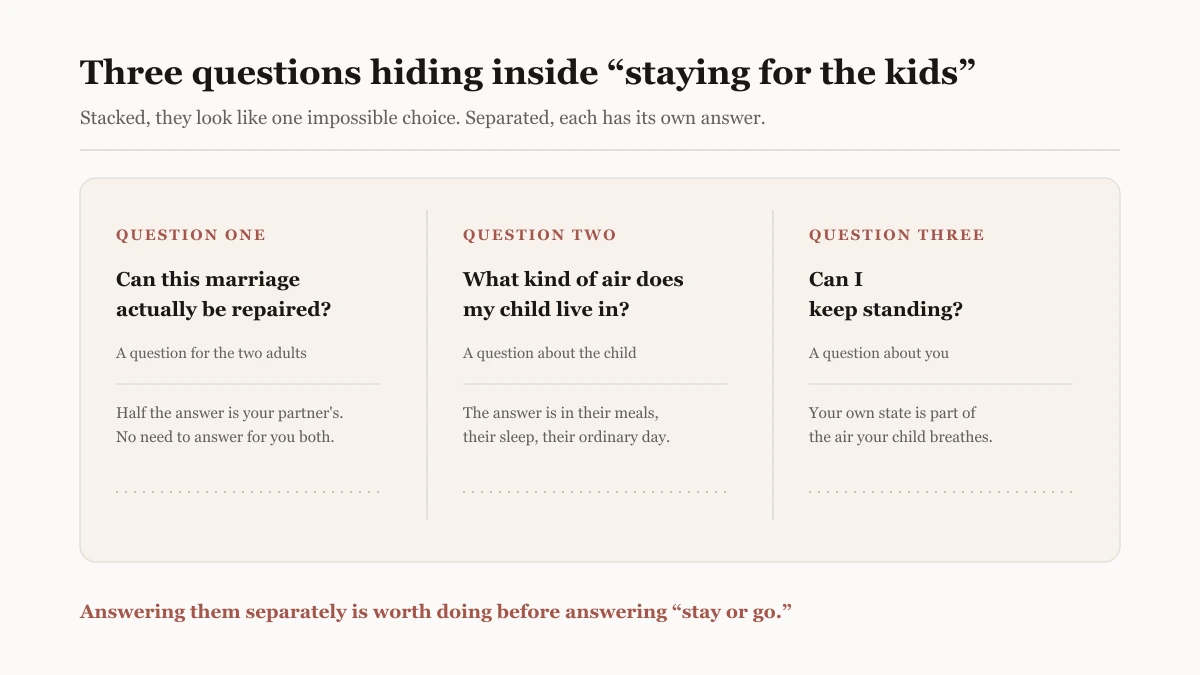
Question one: can this marriage actually be repaired? This one belongs to the two adults. Your child does not owe this marriage an answer, and this marriage does not get to hide behind your child to dodge the question. Whether it can be repaired depends not on how long you can endure, but on what each of you does next. And one thing worth saying now: you probably cannot answer this question yet, because half of the answer is in your partner’s hands — what they do about this, from here on, will write the answer out piece by piece. You do not have to answer for both of you.
Question two: what kind of air does my child live in every day? This one belongs to the child. Look honestly at the house as it is now. Does anyone still talk at dinner? Has your child become unusually well-behaved, unusually quiet, or unusually touchy and quick to anger? Has he started staying in his room, taking the long way around the living room? I want to flag “unusually well-behaved” in particular — my read is that it is sometimes a child trading goodness for fewer explosions. Quiet is not always fine. To check on him, I would watch three places rather than ask “are you okay”: eating, sleeping, and whether he still brings up the things he used to. My judgment is that words can be staged; routines rarely are. The answer to this question is not in your heart. It is in your child’s ordinary day.
Question three: can I keep standing? This one belongs to you, and it is the one you keep crossing off. There is a set of data about the adults rather than the kids: people who stay for years in marriages that make them unhappy score lower on happiness, self-esteem and health than people whose marriages are good enough — while the people who eventually left did not end up worse off than those who kept holding on. I am not putting this here to push you toward the door. I am putting it here because of something that keeps getting forgotten: your condition is not background noise in this house. Your condition is part of the air your child breathes. A parent who spends years just holding on is something a child can see. So “can I keep standing” is not a test of willpower. It is an inventory: are you sleeping? Is there anyone who can take the kids for two hours so you can breathe? If “being worn down” reads painfully familiar, I wrote about that state in Why Does Loving Someone Feel This Exhausting?
Three questions can have three different answers. The marriage may be beyond repair while the air can still get better. The marriage may be repairable while you are close to collapse. Merge them into one question and everyone loses. Keep them apart, and you can finally see where you are actually standing.
Three small things for the next few weeks
Here is what I would advise: make no irreversible decisions in these first weeks — no signatures, no moving out, no announcements in front of the kids. That is not stalling. Everything in you is on fire right now, and a decision the size of “stay or go” deserves to be made by a version of you that is not burning. Until the fire comes down, there are three things that need nothing from your partner and can start today.
First: protect the air in front of the kids. This is not pretending nothing happened — my read is that most kids have already sensed something, and an over-acted normal makes them more anxious, not less. This is simply moving the battlefield. If you two need to talk, schedule it for when the kids are out. If it starts to ignite in front of them, say one prepared sentence — “we’ll talk about this later” — and leave the room in different directions. This works best agreed on by both of you, but even alone you control your half: if you do not fight in front of the kids, the battlefield is already half its size. A postponed fight loses nothing. Your child’s today, once spent, cannot be lived again.
Guarding the air also covers a moment you will sooner or later face: your child asking, “are you two fighting?” I would not answer “no, everything’s fine.” He has already picked up the signal, and a flat denial asks him to choose between doubting himself and doubting you. Give him one sentence that is true but not heavy: “We’re dealing with some grown-up things. It’s not about you. Home keeps going as usual.” Then make “as usual” actually true — that is what holds the sentence up.
Second: take one sheet of paper and draw three columns. One column per question. Write only what can be seen, never what you suspect: what your partner said and did; what actually happened in the house this week — who slammed a door, whether anyone spoke at dinner; how you slept, how many times you swallowed tears in front of the kids. The suspicions — “maybe they never loved me,” “the kids will hate me” — stay off the page — not because they do not matter, but because they cannot be answered, and unanswerable things drown out the ones that can. Come back in a few days. That sheet will be more honest than your brain at three in the morning.
Third: tell the whole story to one person who will not decide for you. A friend who can keep things sealed, or a counselor. The point is not their advice. The point is the act of saying it — inside your head this is one ball of fire; spoken out loud, it turns back into separate things you can look at. As for the people racing to decide for you, whether their verdict is “leave now” or “endure it for the kids”: keep some distance from them for now. You are not short of answers. You are short of room to think.
These three things share one property: whichever road you take in the end, none of them will have been wasted. They do not choose the road for you — they steady you enough to see it.
If you stay, stay in the repair version
If part of you wants to stay — for the kids, for the years, or because you still love them — there is one thing I need to lay out first: staying comes in two versions, and they are entirely different roads.
One version is repair: the affair is brought into the open and faced by two people together. The other version is endurance: the surface returns to normal, the affair becomes the switch in the house no one may touch, and you burn through it alone every night they come home late.
The data draws a sharp line between those versions. Among couples willing to walk into therapy together, where the affair had been brought into the open, more than half were still together years later — and the ones who stayed were as satisfied with the relationship as couples who had never had an affair at all. They were not settling. They actually made it back. Where the affair stayed hidden the whole way through — hidden even inside the therapy room — most of those marriages did not survive.
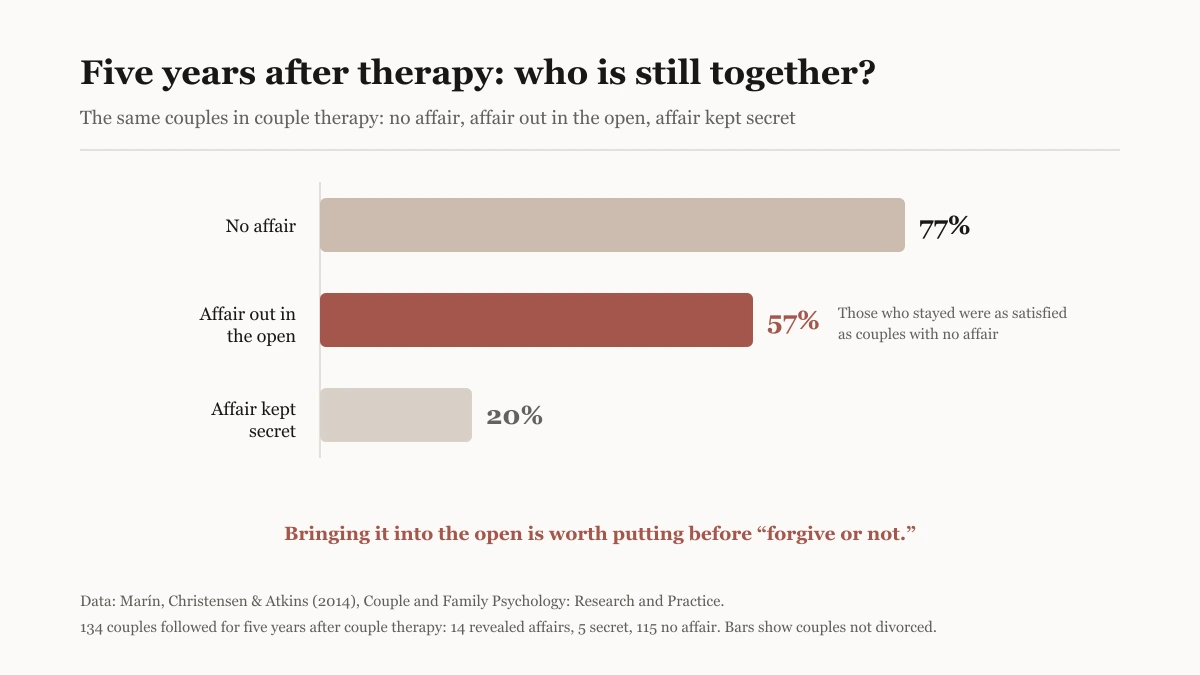
So an affair is not the automatic end of a relationship. That is real hope, not consolation. But look carefully at where the hope grows: it grows on two words, “open” and “together.” Open does not mean making it loud; it means both of you admit this happened and agree it needs working through, instead of burying it under “let the past be the past.” Together means the repairing is done by two people, not by you alone practicing not-thinking-about-it. And one more thing worth knowing early: bringing it into the open does not mean forgiving today. Forgiveness is a result the repair may earn, not the ticket in — you can still be in pain and decide to try. To figure out which version you are living in, I would ask three questions. Did they put the affair on the table themselves — or do they only admit what you have already found? A toothpaste-tube confession, squeezed out one piece of evidence at a time, is not the same as an honest confession — and you should not have to work as a detective for the rest of your life. Is the repairing being done by two people — has “let’s go talk to someone” ever come out of their mouth, or has even forgiveness become homework assigned only to you? And is the air in the house actually changing — not “this week happened to be calm,” but the things that keep you up being taken out and worked through, one at a time? There are two kinds of quiet: the quiet after something has been dealt with, and the quiet of no one daring to speak. You can tell them apart.
And let me set one thing down early: even if all three answers point to repair, the road will not be straight. There will be weeks that look like the starting point again, and nights when what you thought was over comes flooding back all at once. Repair is not forgetting — it is working this thing down until it no longer rules the air of the house. That takes time — and in my judgment, usually a trained third person in the room as well.
If all three answers point to repair, then staying is not self-betrayal. It is a decision worth trying. If all three point to endurance, I have to say my honest judgment: the endurance version is exactly that house where the marriage survives while the atmosphere keeps getting worse. Choose it “for the kids,” and what the kids usually get is three people sinking in the same air — and to a child, that is the cruelest version of all.
If you go, divorce ends a marriage — not your child’s home
It may also be that things are already clear — they are not going to repair anything, or you already know you cannot go back. Then your real question is a different one: will divorce ruin my kids?
I will not hand you a convenient answer, so here is the unpleasant part first. Put children of divorce next to children whose parents stayed married, and on average the first group scores somewhat lower — school, behavior, steadiness inside. The gap exists. I will not hide it from you — my guess is that most of the alarming articles you have seen online about children of divorce trace back to it.
Separate out the homes where the air was already bad and look at them on their own, and the result is completely different: those children stood steadier after their parents parted. The way I read it, for those kids divorce felt less like the sky falling and more like a war that had gone on for years finally ending.
So this is my judgment: what decides whether divorce hurts a child is not the act of divorcing. It is what surrounds it. Does the war actually stop, or does it continue on a new battlefield? Is the child forced to pick a side? Does his ordinary life keep turning — same backpack, same school, someone still saying goodnight? And a ceasefire does not require the two of you to like each other again. It requires clear rules: handovers happen when agreed, whoever’s event it is shows up, and the accounts between adults are never settled while the child is in the room.
If this is the road you are on, I would put your strength into three things. They are closer to the true meaning of “for the kids” than preserving the shape of a marriage ever was:
No messenger duty. “Tell your mother.” “Ask your father.” Every one of those sentences stands a child between two people he loves, and asks him to practice a skill no child should have to learn: filtering messages between you, reading faces to decide how much to say. Adult words get delivered by adults, however hard that is.
No trials held in front of the child. This may be the hardest of the three, because you are full of grievances and your grievances are real. But to your child, the two of you are each half of who he is. Every accusation he hears, he may quietly turn on himself: is that half in me too? Holding your tongue is not whitewashing what your partner did — it is sparing your child a civil war inside himself. The grievances deserve a hearing, in front of adults — the person who will not decide for you, or the chair in a counseling room.
Let “this is not your fault” be proven by days, not said in words. Saying the sentence takes one second. The hard part is every day after. My judgment is that children believe days more than declarations — whether your face can hold steady when he mentions the other parent, whether the things on his calendar still have someone showing up, whether his life keeps its familiar shape.
You don’t have to answer today
Back to the question in the title: my partner cheated — should I stay for the kids?
Now I can give you my whole answer. “For the kids” is a reason that deserves respect — and it deserves a more precise job than “don’t divorce.” What your children need has never been for your marriage to hold a particular shape. They need air they can breathe, and at least one adult still standing. Staying to repair can provide both. Leaving well can provide both. Gritted-teeth endurance fails the first. Scorched-earth leaving fails the second.
So the real choice was never “stay or go.” It is which road you will take to provide those two things. Nobody can answer that for you — and it does not demand an answer today. Today only asks for the small things you can already do: guard the air in front of the kids, tell the story to one person who will not decide for you.
One last thing before you close this tab. My guess is that one day, looking back on this stretch of your life, what you will remember is not the legal shape your marriage ended up in. It is whether, while everything was burning, you protected your child — and yourself. Counting from the moment you opened this piece and read it to the end: you are already doing both. And what you still have time to do is more than it feels like tonight.