Why Do My Parents Always Put Me Down? What Years of Criticism Can Leave Behind

It was something you had wanted to learn for a long time, and you said so to your parents. Before you could finish, they cut in: “You? You never stick with anything. What’s the point of learning that?” Then came the line you have heard since you were small: “You’ve always been like this. You’ve never done a single thing right.”
You stopped talking. That night, one question was all that was left: “Why do my parents always put me down?”
You keep coming back to it because what they think of you matters to you, and because you have hoped, just once, that they would be on your side.
The moment it is said: why do your parents always put you down?
I think there may be several reasons. Sometimes there really is something you could do better, but that does not need to be said in a way that belittles you, much less for years on end. They may worry that you will lose out, that if you feel satisfied too early, others will get ahead of you once you are out in the world. They may believe that speaking a little harshly is what makes you improve, and that praise will make you ease off. They may have been raised the same way, by people who never told them “You did really well,” so they never learned how to say it. Or they may be under pressure themselves, and it comes out as impatience with you. My guess is that in many families, these reasons are tangled together.
As for why it is “always,” here is how I see it. For them, each time is just one passing remark, said and then over. For you, it is the same kind of remark, heard from childhood on, one after another, and it never really ends.
But whatever the reason, the weight those words put on you is real. They may have spoken out of worry, and that worry does not make years of hurt any lighter.
The moment you hear it: you took it as fact
As a child, you had no way to judge whether your parents were right. They were the adults you trusted most, and the first people to tell you what kind of person you were.
So when they said “You’re just stupid” or “You never stick with anything,” it did not occur to you to doubt them. You took it in as a fact about yourself.
In my view, this is where years of being put down go deepest. Those words were only your parents’ judgment of you, not facts about you, but after years of hearing them, they become the things you say to yourself. Even when your parents are not around, the words are still there, only now in your own voice.
Try this: “The line you most often use to scold yourself: whose tone of voice is it in?” If you recognize it, if the words are almost the same as what your parents used to say, then it is their old judgment, carried all the way into the present. If you reached that conclusion yourself after looking at what actually happened, then it is something you can deal with: you can check it, and you can change it.
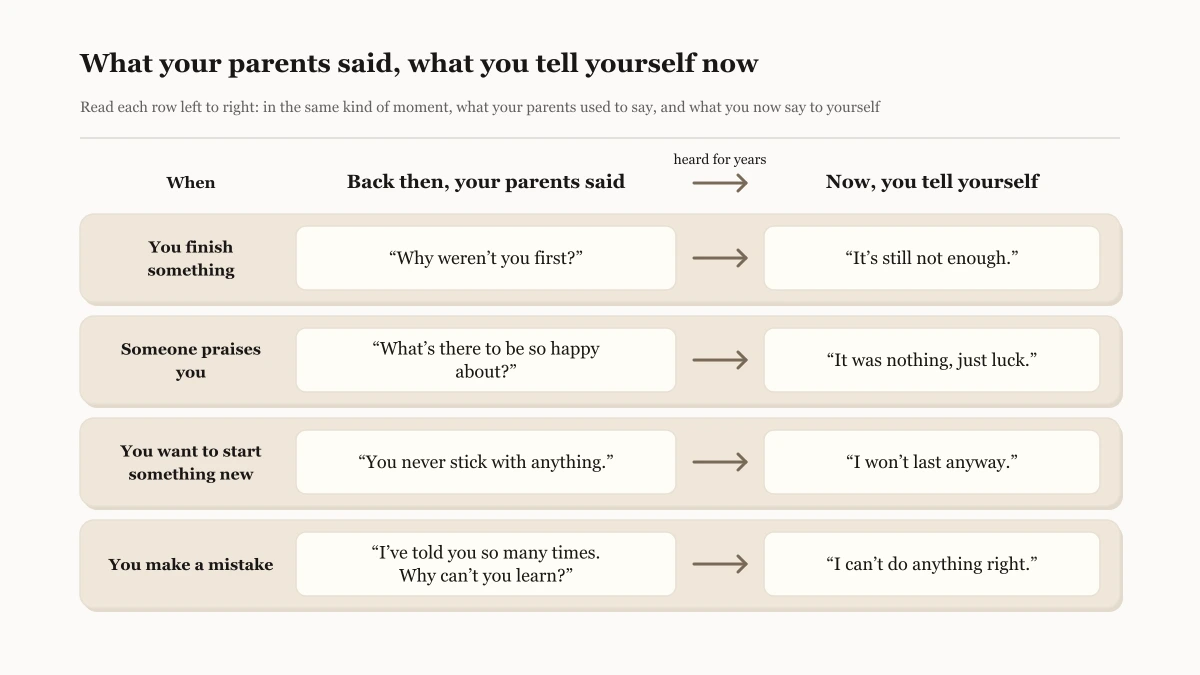
Years later: what long-term criticism from your parents can leave behind
Words heard for years do not stay in childhood. I think they show up again in adulthood in a different form: in how you look at your finished work, how you hear praise, how you make decisions, and how you treat your own mistakes. You may recognize one or two of these, or every one of them.
Never feeling it is good enough
When you finish something, the first thing you see is what went wrong: the one typo in the report you handed in, or the dish everyone enjoyed that you think was a little too salty. Even when you succeed, the happiness does not last long, because the next thing you have not done yet shows up right away. Here is how I see it: as a child, the first thing you heard after finishing anything was about what was missing. After years of that, your own eyes learned to look for the gaps first. Now you do not need to wait for your parents to say it, because you have already said “what’s missing” for them.
Brushing off praise
Someone says, “You did a great job on this.” Out comes “Oh, not really,” or “I just got lucky,” or you quickly add what was not quite right.
It is not entirely politeness. The praise does not sound quite real, and you are not sure where to put it.
From what I have seen, praise is hard to accept because it does not match what you heard growing up. You already have an answer about yourself, built up one critical remark at a time. When someone suddenly says the opposite, your first reaction is to doubt it rather than believe it. Over time, even when you do something well, you hesitate to be the first to tell anyone.
Hearing your parents before you even start
You want to try a different path, say an idea out loud, or try something you have never done, and before you begin, their voices are already in your head: “Do you know how to do that?” “Forget it, that’s not something you can do.” Sometimes you stop there and do not try at all. My guess is that this is a way of protecting yourself. As a child, when something went wrong, it was often not only the mistake that got criticized; there was also “That’s just how you are.” So you learned to expect the worst line in advance. If you never start, no one can tell you that you failed, and that really did spare you a lot of remarks. Later, though, it also left you doing far fewer of the things you wanted to do.
Scolding yourself in your parents’ words over small mistakes
You knock over a glass of water, forget to answer a message, or say the wrong thing in front of other people. Each of these is small, yet you spend the whole evening scolding yourself in the same words you heard back then: “Why did you do that again?” “You can’t even get something this simple right?” Everyone else has forgotten. You are still going over it.
The way I see it, beating yourself up first is a kind of preparation you learned as a child. If you have already scolded yourself, it seems to hurt less when someone else speaks up. The cost is that every small mistake lands on you twice: once with its real weight, and once with the weight of the words you remember.
I believe each of these was learned one remark at a time, and what was learned that way can be replaced the same way, one remark at a time.
Now: your turn to answer your parents’ criticism
You are grown now, and you can do something you could not do as a child: first work out whose words those are, then answer them.
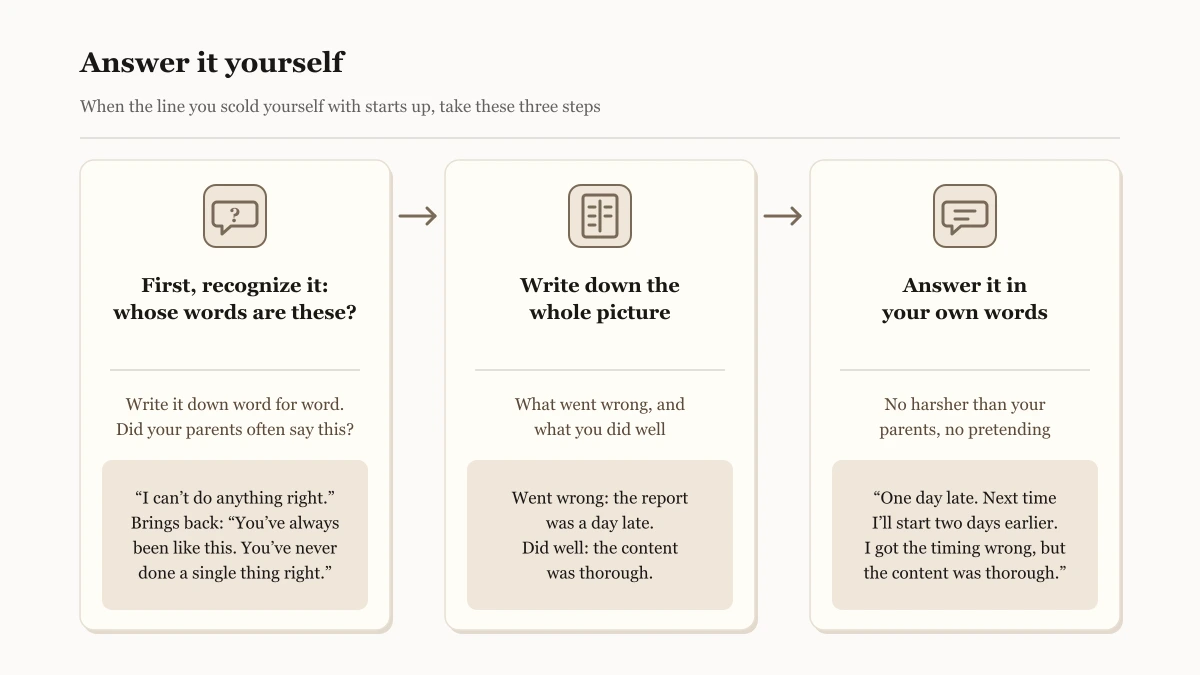
The line you scold yourself with tends to start up at three moments: when you have just made a mistake, right after your parents have said something, and when you want to do something but already hear what they would say. The next time it does, I would suggest getting out paper or your phone and writing it down in these three steps.
First, recognize it: whose words are these?
Write down the line in your head, word for word, then ask yourself: did my parents often say something like this? Say you wrote “I can’t do anything right.” Thinking back, you may remember your parents’ line: “You’ve always been like this. You’ve never done a single thing right.” Once you recognize it, you know you picked this line up long ago; it is not something you worked out yourself this time.
Write down the whole picture: what went wrong and what you did well
Next, write down all of what happened this time. Be honest about what went wrong, such as “I turned in the report one day late.” Then write down what you did well in that same situation, such as “The content was thorough.” I suggest this because a situation rarely consists of mistakes alone: the report was late, but the care you put into the content is still there. Your parents’ old words picked out only the half that went wrong. When you write down the other half too, you see the whole of what happened.
Answer it in your own words
Put the first two steps into one sentence and say it to yourself, silently or quietly out loud: “One day late. Next time I’ll start two days earlier. I got the timing wrong, but the content was thorough.” Use the tone you would use to comfort someone you care about, no harsher than your parents, and without pretending nothing happened.
After that, if the voice scolding you has gotten a little quieter, go on with whatever you were about to do. If it is still loud, stop at step one for the day: recognizing whose words they are is enough, and the rest can wait until tomorrow. If your parents put you down in person again, run through the same three steps in your head. You do not have to talk back on the spot or convince them to take it back. What they say is theirs; how you answer it is now up to you.
Wanting to hear “You did really well” from your parents is a reasonable hope
As I see it, you keep feeling not good enough because you heard those words before you could tell whether they were true. You took them as true, and ever since, they are what you have used to look at yourself. Hoping your parents will one day say “You did really well” is a very reasonable hope for a child, and it still is now that you are grown. You do not have to tell yourself to stop wanting it just because you have not heard it yet.
While you wait for those words, you can start by saying them to yourself. When you finish something, say what went well before what needs to change. When someone around you does something well, tell them what they did well first. You heard those old words for many years, and they will not go quiet overnight; some days you will still believe them. That is all right. You can now hear whose voice that is, and in the days ahead you can slowly swap it for what you would rather say to yourself.
Sources
Research and sources this essay draws on.
- Person versus process praise and criticism: Implications for contingent self-worth and copingDevelopmental Psychology, 35(3), 835–847
- Family origins of adolescent self-criticism and its continuity into adulthoodJournal of Abnormal Psychology, 100(2), 191–197
- Young people’s perceptions of their parents’ expectations and criticism are increasing over time: Implications for perfectionismPsychological Bulletin, 148(1–2), 107–128