When Your Parents Control Too Much: The Line Between Managing Your Life and Managing Your Feelings

The call was going fine until you mentioned it. The new place closer to work, the job you are leaving, the weekend you are not coming home, whichever it was this time. Three questions came, you answered all three, and then nothing. A breath out, a “do what you want”, and the call ended a little earlier than usual. If you still live at home, the same thing plays out in the next room: the sigh, and then an evening in which nobody speaks to you. The move, the job, the weekend away: what you said you would do has not happened yet, and you are already wondering whether to let it go. That is when the question shows up: “My parents control too much. What do I do?”
The things you have not said out loud
“I am an adult. Why do I still have to report to them?” Reporting is not something your age decides. It is something nobody between the two of you has changed yet. It may have come up before, or it may not, but until it actually changes you are still the one who reports, and that has nothing to do with how old you are. “Am I being a bad child?” The way I read it, a person who asks that is a person who still cares what their parents think. Someone who has stopped caring does not ask; they act and then stop picking up the phone. You paused to ask, and that shows you are trying to find a way where you and your parents both come out all right, not just you.
“Why are other people’s parents not like this?” The way I see it, what you see of other people’s parents is their outside face, the same face your parents wear in front of relatives. Whether the words “do what you want” have been said in someone else’s kitchen, you were not there. You only know your own house. This comparison puts what you can see against what you cannot, and I think it will lose every time. “I did what they wanted and I am not happy at all.” While you were doing it their way, what you were waiting for was the sighing to stop and for them to talk to you again. Their mood you got. What you set out to do, the move, the job, that weekend, none of it happened. You traded what you wanted for their mood, and when the trade was over you found you were holding nothing.
“Will I ever be able to decide for myself?” My judgement is that you already do. You decide things at work, things with friends, how each day goes. Only the handful that touch your parents are still open, and not because you cannot do them. Each time you get halfway, their mood is standing there. Something standing in the way can be moved. Every one of these questions asks whether you have the right. Not one of them asks what, exactly, they are objecting to.
A parent’s objection comes in two kinds
Managing your life: they talk about the matter itself
When you come home, who you date, which job, how your room is arranged, whether you visit this weekend. A parent having opinions about these is managing your life. When they object this way, they talk about what is wrong with the matter itself: “coming home that late is not safe”, “is that company stable”, “you were just here”. This kind of objection can be answered. You can disagree with it, you can argue about it, and when the argument is over, what you wanted to do is still there. You may still be angry, but you know what you are angry at: their view of the matter.
Managing your life, I would say, is a worry spoken out loud, just spoken hard. You can decline to follow it, they can keep disagreeing, and neither of you loses anything.
Managing your feelings: they talk about how they feel
Same decision, different objection. This time they do not say what is wrong with the matter itself. They talk about how they feel: “after everything I did for you”, “are you trying to kill me”, “fine, I am done, do what you want”. Then the sigh, the evening without a word, the crying, or “you know my heart is not good”. What you have to deal with now is not the matter itself. It is their feelings, and their feelings have exactly one fix: you give up what you wanted to do. That is managing your feelings.
Given enough of it, something happens that I want to say plainly: you give up before they have even opened their mouth. You know that the moment you mention moving out the sigh and the silence will come, so you do not mention it at all. That is where managing your feelings really reaches. It does not govern whether you do what you wanted. It governs whether you dare to think about it.
The line: do they talk about the matter itself, or about how they feel
Between managing your life and managing your feelings, here is the line I draw: when they object, do they talk about the matter itself, or about how they feel? Talk about the matter itself can be answered: “coming home that late is not safe” gets “I will text you when I get in”. Talk about feelings cannot; whatever you answer will be wrong. There is nothing in “after everything I did for you” to take hold of, and the only thing that settles it is you giving up.
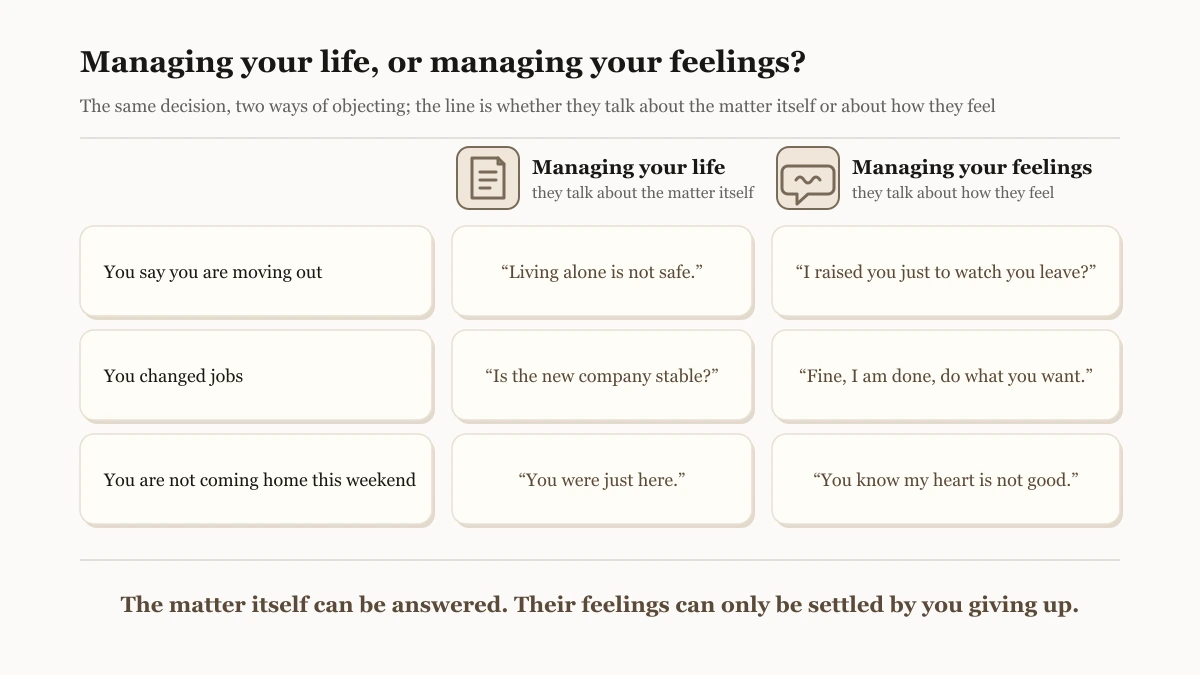
The same parent can do both in one day. In the morning it is “is that company stable”; by night it has become “so you do not want this family any more”. The line is drawn one sentence at a time. It is not a label for your parent, and you never have to decide which kind of parent they are. You only have to hear, in the second they speak, whether the sentence is about the matter itself or about how they feel.
How it goes from managing your life to managing your feelings
Controlling does not grow in a day, as I see it. When you were small, everything they managed was a matter of daily life: what you wore, what you ate, when you slept. That was managing your life, and at that age most of those decisions were being made for you. Growing up happened slowly, and no day ever came when someone told them “from today these are his, you can stop”, so they kept going.
You came to have your own school, your own friends, your own work and your own time, and every year there was less of your life left for them to manage. The worry did not shrink with it. When nothing in your life is left to manage, the only thing left is your feelings. So they talk about the matter itself less and less, and about how they feel more and more. That is why, from managing your life to managing your feelings, I think you are often looking at one parent in two stages, not two kinds of parent. This is not an excuse for them. It is so you know that the change can start on your side: whether they stop is not yours to decide, but whether you take their feelings on is.
What to do when your parents control too much: answer only the matter itself
My answer is this: listen for whether, this time, they are talking about the matter itself or about how they feel, and then answer only the matter itself.
When they talk about the matter itself, answer only that matter. “Coming home that late is not safe” gets “I will text you when I get in”. “Is that company stable” gets “I asked around, I am giving it a year”. Answering is not the same as obeying. Whether you go ahead is still your call. You have simply treated their worry as something that can be talked about. When they talk about how they feel, do not take it. Not taking it means: no explaining, no apologising for their mood, no pulling back what you wanted to do to make them happy, and no walking out either. They sigh; let them. They go quiet; let them. They say “are you trying to kill me”, and you hear it and do not answer, because there is nothing in it to answer. Their feelings are theirs. You do not have to fold them up and put them away for them.
There is a half of this that belongs to each of you. Their half is objecting with their feelings; that is their habit, and you cannot change it. Your half is that every time they bring up their feelings, you take them on as something you have to deal with, and that you can change. You cannot change what they say. You can change what you take.
The practice: split the sentence in half
The next time they speak, split the sentence in your head before you answer: the half about the matter itself, and the half about how they feel. Then answer only the half about the matter itself. “Coming home that late is not safe, and after everything I did for you this is what you do?” The first half is about the matter itself; answer it. The second half is about how they feel, so there is nothing there to answer. When the whole sentence is about how they feel, you do not have to answer any of it. “I can see you are upset” is enough, and then you stop.
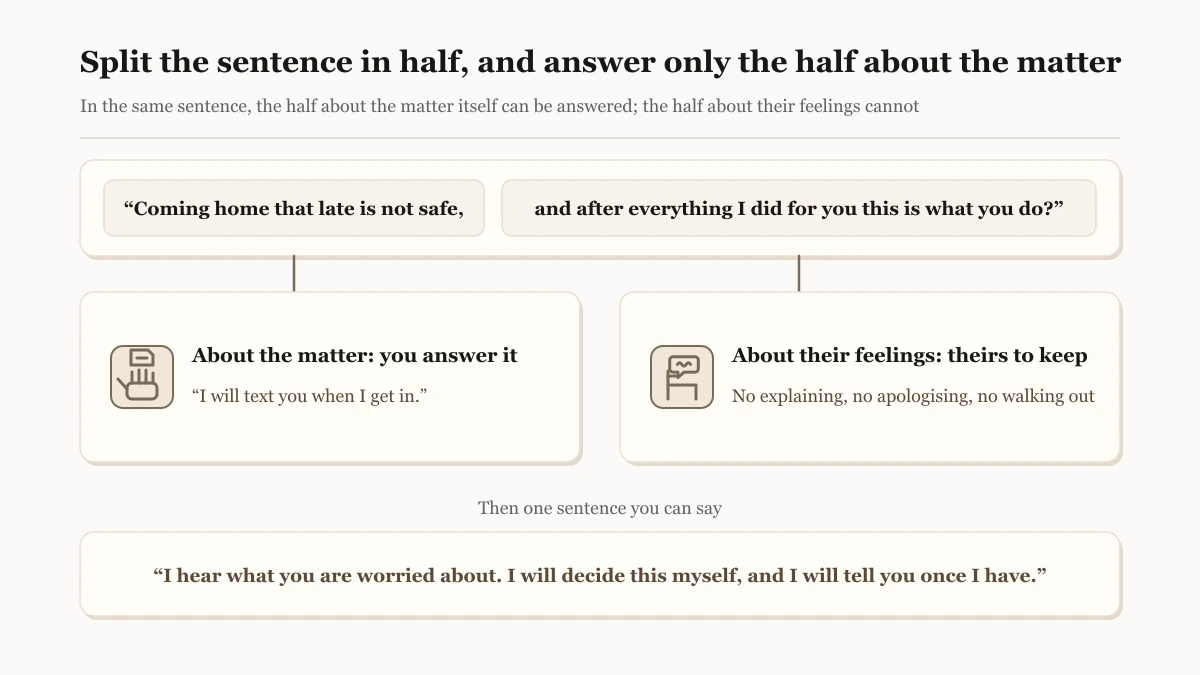
Then there is one sentence you can say, face to face if you live at home, over the phone if you do not: “I hear what you are worried about. I will decide this myself, and I will tell you once I have.” It does three things. It answers their worry, it keeps your decision, and it does not push them away. It asks no permission and demands no change from them. It puts what you wanted to do back in your hands and, in the same breath, tells them you are not leaving. You do not need their agreement to begin. I would begin with the smallest thing, small enough that even if they are unhappy, you can carry it: which day of the weekend you go home, where things go in your room. One thing at a time. Once it is said, what you wanted to do is, for the first time, something you decided, not something they agreed to.
The four things you will actually ask next
“What if they keep going, and keep asking?”
Listen to what this particular round is about. The first time, it was about the matter itself, and you answered it. My judgement is that the second and third times are no longer about the matter but about how they feel: “why do you never listen”, “how many times have I said this”. Those do not need an answer. You can say “I know you are still not at ease” and go and do what you were going to do. Saying it again does not turn a feeling into a problem with the matter itself, and you do not have to turn it into one on their behalf.
“Can I just do it and tell them afterwards?”
Yes. Doing it first is a decision too. The sentence “I will tell you once I have” is said to them, not asked of them. The difference is whether they hear it from you or from someone else. I would tell them yourself once it is done, with these words: “I have decided. I wanted you to hear it from me.” Even if they are unhappy, you did not hide it from them. If they hear it from someone else, their feelings get one more thing added, and that thing is you hiding it.
“I still live with them. Does that mean I get no say?”
You get a say. The rules of a shared house can be talked about: whether to say something when you will be late, where things go, who washes up. Those are the kind of matters that only exist because you live together. What you want is not something you pay for with where you live. When they say “under my roof you do as I say”, you can answer: “I live here and I will keep to the house rules. What work I do, I decide.”
“Going along with it is easier. Should I just let it go?”
You can let it go, but be clear about which of two things you are doing: choosing to go along with it, or going along with it without ever choosing. Choosing means you thought about it and decided not to do it this time; the idea is still yours, and you can pick it up again when you want to. Going along without choosing means you gave up the moment you heard the sigh, without thinking at all; the idea was stopped by their mood. An idea stopped that way does not disappear. The next time the same decision comes round, you will be stuck in the same place. So I am not asking you to fight every one. Pick one small thing, which day of the weekend you go home, say, and finish that one. Then you know you can.
Answer only the matter itself, and what you wanted to do comes back to you
So, what do you do when your parents control too much? The way I see it, the controlling continues because every time they bring up their feelings, you take them in and give up what you wanted to do. The more you take, the more often they object with their feelings, and the less they talk about the matter itself.
There is one change to make: answer only the matter itself. When they talk about the matter, answer that matter; when they talk about how they feel, do not take it. Their feelings stay with them, and what you wanted to do stays in your hands. First which day you go home, then the job, then where you live, one piece at a time.
After that, you will still argue, about what time you got in and about that job. The difference is that when the argument is over, what you wanted to do is still there and so are the two of you. Nobody is trading a mood for what the other person wanted. I think that is better than what you have now, because right now you do not even dare to want. You do not need their agreement to grow up. You can start by answering the matter itself, and nothing else.
Sources
Research and sources this essay draws on.
- Parental Psychological Control: Revisiting a Neglected ConstructChild Development, 67(6), 3296–3319
- A theoretical upgrade of the concept of parental psychological control: Proposing new insights on the basis of self-determination theoryDevelopmental Review, 30(1), 74–99
- Tensions in the parent and adult child relationship: Links to solidarity and ambivalencePsychology and Aging, 24(2), 287–295