Does Keeping Your Distance from Family Mean You've Failed Them? Rethinking What Healthy Family Love Looks Like

Nobody said a word, and you had already scolded yourself anyway. That’s what stays with you after the photo.
It landed in the family group chat: tonight’s dinner, the same dishes as always, including the one you’ve loved since you were small. Only your bowl and chopsticks were missing. No caption came with it, yet you supplied one yourself: Does staying away like this mean I’ve failed my family?
Deep down you know why you don’t go home much. It’s just that none of those reasons feel like something you’re allowed to say.
Keeping your distance is not the same as failing your family
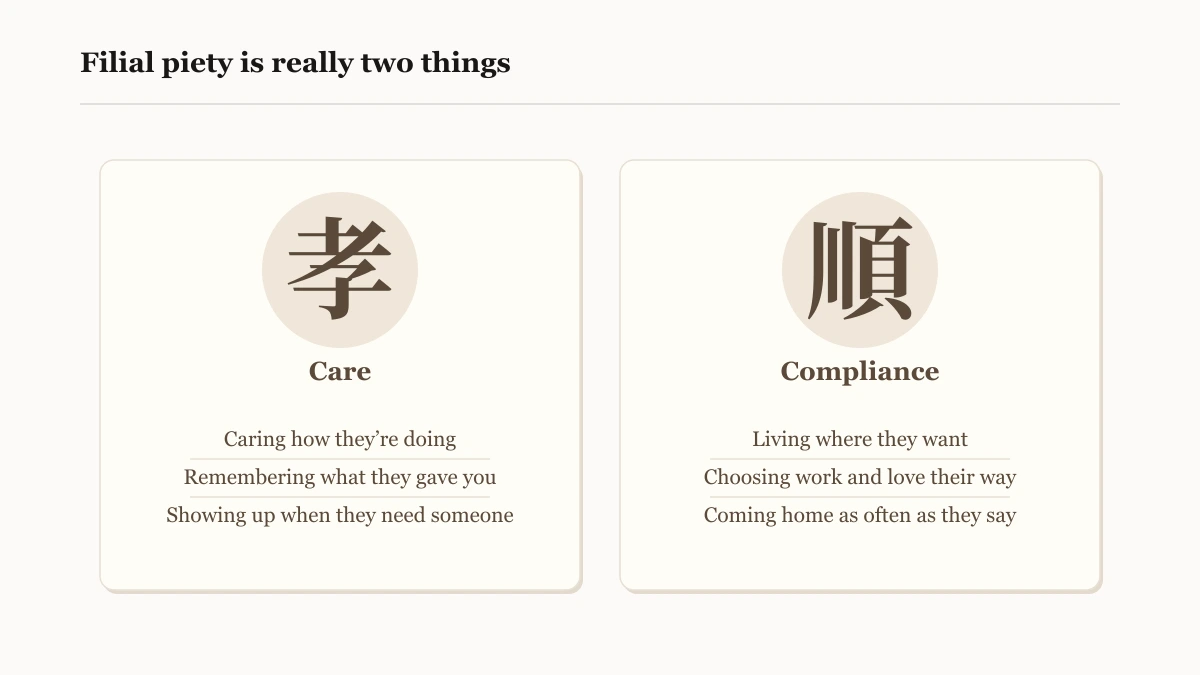
As I see it, keeping your distance from your family does not mean you have failed them. The Chinese word for filial piety, xiaoshun (孝順), is actually two characters joined together.
The first, xiao, is care: minding how your parents are doing, remembering what they gave you, and showing up when they grow old, fall ill, or need someone. The second, shun, is compliance: living the way they want, so that where you live, what work you do, who you’re with and how often you come home all wait on their approval.
Distance mostly takes away from the second, not necessarily the first. Someone can rarely go home and not follow their parents’ plans, and still be the child who remembers their birthdays and rushes back when they’re in the hospital. The trouble is that the two characters have been said together since you were small, so the moment you stop complying, it feels as if the care has gone too.
There’s a line in the Analects of Confucius that many people only remember the first half of: “While your parents are alive, do not travel far; if you do travel, let them know where you are.” To me, even this line about filial duty, written more than two thousand years ago, never asked children to stay by their parents’ side forever. What it cared about was whether parents knew where you were and how you were doing.
Still, seeing you less may leave your parents genuinely missing you, the house a little too quiet. That longing is real. You can keep it in mind without handing over the life you have now to fill the gap.
Why you might want distance from your family
People rarely pull back from their family because one day they suddenly stopped loving them. From what I’ve seen, the same things have usually been happening at home for years, speaking up hasn’t changed them, and stepping back is the only option left.
Going home turns you back into your younger self
Out in the world you run your own life: you make decisions, handle problems, and look after other people. Then you walk through your parents’ door, and they talk to you exactly as they did when you were a teenager. What time will you be back, aren’t you cold in that, is that job really stable: every line reminds you that in this house you’re still the kid. Worse, you notice yourself sliding back too, snapping when you’re nagged, or going quiet and getting through dinner in silence.
I think a lot of families run into this. The children grow up, but the way the family treats them doesn’t change to match. Stay long enough and it’s hard to believe you are who you’ve become, so you want to get back to your own life, where you don’t have to keep proving you’ve grown up.
Every visit ends in the same argument
It might be work, relationships, where you live, whether to marry, or simply that you see a lot of things differently. Once you’ve had the same argument many times, it’s no longer an exchange of views. You’ve heard everything your parents have to say, and they know where you stand. My guess is that what you’re really fighting about isn’t which choice is better, but whose life it is and who gets the final say. Nobody wins this kind of argument. Each round leaves everyone a little more worn out and a little more tense before the next visit, and going home less at least puts it on hold for a while.
You’re the one the family always calls
Maybe your parents call you when there’s tension between them, relatives use you to carry messages when they’re at odds, and when the family has a decision to make, everyone waits for you. You’ve become the one who listens to everyone and finds a way through for everyone, and over time you’ve learned to swallow your own bad days. Wanting distance means wanting to keep some strength for your own life instead of managing the whole family’s feelings.
Some old hurts get shut down the moment you raise them
It might be harsh words you heard as a child, the years of being compared to someone else, or the stretch of time when you badly needed someone and nobody was there. Once you’ve grown up, you try to bring one of them up, and you hear “That’s all in the past,” “We did it for your own good,” or “Why do you hold such grudges?”
After being shut down once, it’s hard to speak up again. But things that never get talked through come back every time you go home. So some people keep their distance because it’s hard to rest in a place that keeps reminding them of old hurts.
All of these share one thing. At home, saying “no,” saying “I want to decide this myself,” or saying “that really hurt me” never got heard. From what I’ve seen, distance is one of the few boundaries you can set without your family’s agreement. So wanting distance often doesn’t mean you’ve stopped loving them. It’s that you’ve run out of other ways to catch your breath in this relationship.
Healthy family love means staying yourself when you’re close to them
Family therapy has a concept called differentiation of self, introduced by the American psychiatrist Murray Bowen. It describes being emotionally connected to your family while still keeping your own thoughts, feelings and decisions. When your family is upset, you care, but their distress doesn’t carry you off. When they disagree with you, you can listen and calmly say what you think, without needing to win or to run.
When differentiation is low, Bowen believed, people and their families tend to fall into one of two patterns:
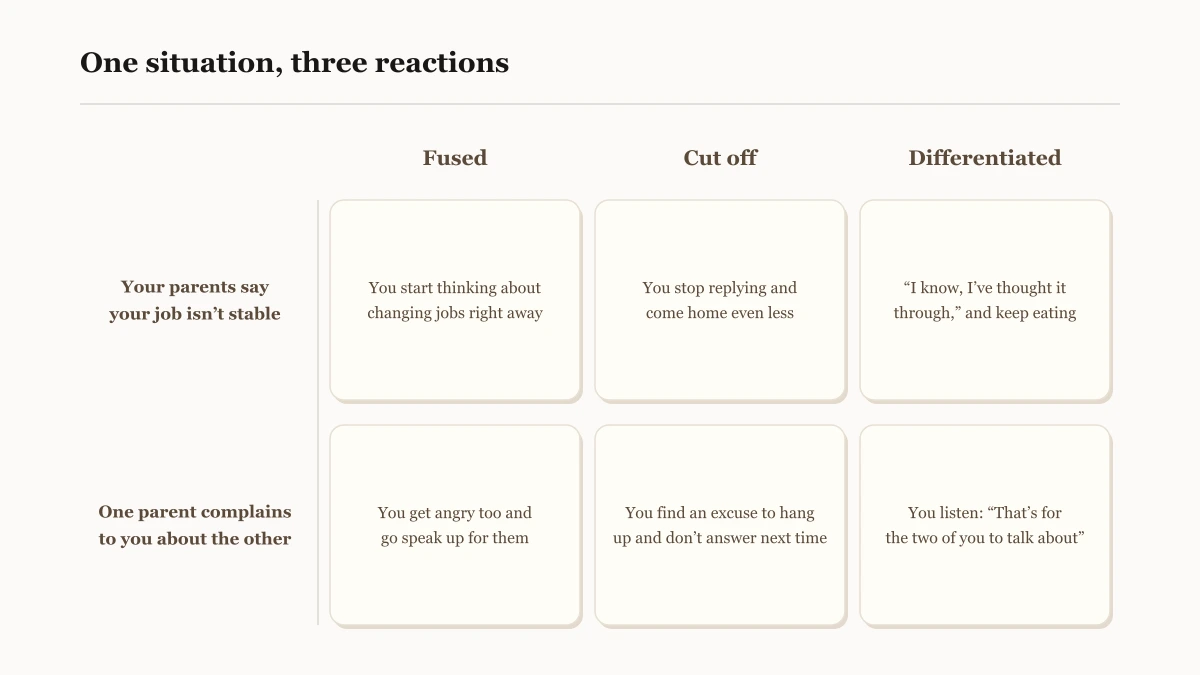
- Fused. When one person is unhappy, everyone is unhappy. Before any decision, you think first about whether your parents will be upset, not whether you want it. Their feelings seem to be your job.
- Cut off. To stop being affected, you contact them less, stop going home, and stop telling them anything. It looks like a lot of distance, but one message from your parents can leave you upset all evening, and within minutes of walking in the door you’re your younger self again. In Bowen’s view, cutoff isn’t real separation. Your family still steers your mood; they just do it from farther away.
A healthy family relationship sits between these two. It might look like this. Your parents worry about your job and say so once; you take it in, answer “I know, I’ve thought it through,” and the family goes on eating. One parent complains to you about the other; you can listen without taking sides or fixing it, and say, “That’s something the two of you need to talk about.” You say “not this time,” and your family is disappointed, but they still call the next day as usual, and the relationship doesn’t break over it. Differentiation isn’t only the child’s job, either. In a healthy family, parents have their own lives, friends and interests, and don’t need every choice their child makes to prove they’re good parents.
So distance itself isn’t the point. What matters is whether, in that distance, you’re slowly becoming more able to be yourself, or just running. I’d tell the two apart with one question: since stepping back, when you think of your family, do you feel calmer, or are you still arguing with them in your head? If you feel calmer, I believe the distance is healthy, and you’re using it to find your own pace again. If you’re still arguing in your head and tense up at any mention of home, the distance looks more like cutoff. In that case, I’d suggest that besides keeping some distance, you also start practicing saying what you think in front of your family.
Making the distance a healthy one
Say it clearly instead of slowly disappearing
Many people keep their distance by picking up the phone less, replying more briefly, and finding reasons to skip Lunar New Year. When you fade out like this, your family can only guess: are you angry, did something happen, do you not want this family anymore? I suspect the more they guess, the more often they call and the more urgent the questions get.
Instead, choose a calm moment and explain your plan once. For example: “From now on, I’m going to be coming home a bit less. I want more time for my own life. I’m not angry with you, and I’ll still call often.” They might respond in a few ways:
- If they say okay, or just “Take care of yourself,” live by the plan you described. No more explaining is needed.
- If they ask, “Did we do something wrong?”, you can say, “There are things I want to think through on my own first. I’ll tell you when I have.” You don’t need to lay out every reason on the spot.
- If they’re angry and say you’ve changed, or that you’re failing them as a child, don’t argue. You can answer, “I can see you’re upset, but I’m still going to stick to this plan,” and then do what you said. My guess is that seeing your words and actions match will settle them more than ten explanations would.
Use the distance to sort out what you actually want
With some distance, you finally have room to hear yourself. Take a sheet of paper and write down a few important decisions you’ve made lately, such as changing jobs, moving, or whether to stay in a relationship. Next to each one, ask yourself: did I choose this because I want it, because I was afraid of disappointing my parents, or deliberately to be different from them? I believe that once you’ve sorted this out, the next time your family weighs in on a decision, you’ll know better what you truly need to hold on to and where you can give a little, and that matters more than winning any argument at the dinner table.
When you go home, say what you think once
Keeping your distance doesn’t mean never going home. When you do, the familiar question will come up sooner or later, and you can practice one thing: calmly say what you think once, then stop there. Don’t argue to win, and don’t walk out. If you’re asked about your love life, you might say, “I know you worry. I have my own plans for this, and I’ll tell you when I’ve figured them out.” If they keep asking, say once more, “Let’s not talk about this today,” then change the subject and stay at the table.
That is what practicing differentiation looks like: your family has their feelings in front of you, and you stay yourself in front of them. You may not get it right at first. The conversation may slide into a fight, or you may go back to saying nothing. That’s normal. Just try again next time.
What you want is healthy family love
You want distance from your family, and the wish itself hurts. Here’s what I think is happening: you care about them and you care about yourself, and at home those two kinds of care have never been able to sit side by side. So you buy a little room with distance, then let guilt pull you back.
Being close to your family while staying yourself: to me, that’s what healthy family love should look like, and it’s not strange at all that you want it.
None of this has to happen at once. When you miss your family, you can send them a photo of something that reminded you of them, with nothing asked in return. When guilt grabs hold of you, you can remind yourself, “I can love them and still live my own way.” You can adjust the distance slowly. Once you’re more able to be yourself around your family, maybe one day you’ll find you want to go home a little more often.
Sources
Research and sources this essay draws on.
- The Analects, Book IV (Li Ren)Chinese Wikisource
- The Differentiation of Self Inventory: Development and initial validationJournal of Counseling Psychology, 45(3), 235–246
- Intergenerational Solidarity and the Structure of Adult Child-Parent Relationships in American FamiliesAmerican Journal of Sociology, 103(2), 429–460