Is It Normal Not to Like Your Parents? When Family Is Only Duty and Pressure

By the time you hang up, you notice something: in the whole call, not one line was just talk. It started the way it usually does. Your phone buzzed on the table, the screen said “Mom,” and you let out a breath before you answered. Your cousin is getting married next month, can you come home that weekend? The money for this month arrived. How is work, are you saving anything? Oh, and the neighbor’s kid just got promoted to manager. You answered each one, more than ten minutes of it, and then you put the phone down with a question you don’t dare ask anyone: is it normal not to like your own parents?
People who ask that have usually kept their parents on their mind all along. You pick up the phone, you go home, you give what you are supposed to give. You care about being a good child, which is exactly why not liking them hurts this much. The hurt itself shows how seriously you take this relationship.
The questions you keep to yourself
“Am I failing my parents as their child?” Being a dutiful child is measured by what you do, and you keep doing it. You answer the calls, you show up, you hand over what is expected. What you feel inside does not erase any of that.
“They raised me. How can I not like them?” Remembering what they did for you belongs to the past; feeling drained around them belongs to the present. Both can be true at once. You can be grateful to them and still breathe out in relief when the call ends.
“Everyone else seems close to their parents. Why can’t I be?” What you see from other families is usually the best angle: a photo from a family trip, a message on a birthday. From what I have seen, plenty of people find time with their parents exhausting and never mention it. Like you, they don’t bring it up. “I start dreading the visit a day early. Does that make me cold?” You dread it because you already know how it will go, which questions will come and which comparisons will be brought out. You feel tired in advance because you still remember clearly how tiring the last visit was.
“Do I have to like them before I count as a good child?” No. Here is how I see it: a good child carries out the responsibilities they have decided to carry. Liking is not on that list.
Is it normal not to like your own parents?
I think it is, and there is a reason for it. Liking someone comes from how it feels to be with them: talking is easy, being in the same room is comfortable, you look forward a little to seeing them. Those feelings build up over many ordinary moments together, and they do not appear automatically because someone is your parent. If those feelings have been missing between you for a long time, I believe almost anyone would find it hard to like the person across from them.
Try this question on yourself: when was the last time you talked with your parents and there was nothing to deal with? If nothing comes to mind right away, write down what was said on your most recent call and sort each line into one of three boxes: things to handle, questions and comparisons, and plain conversation.
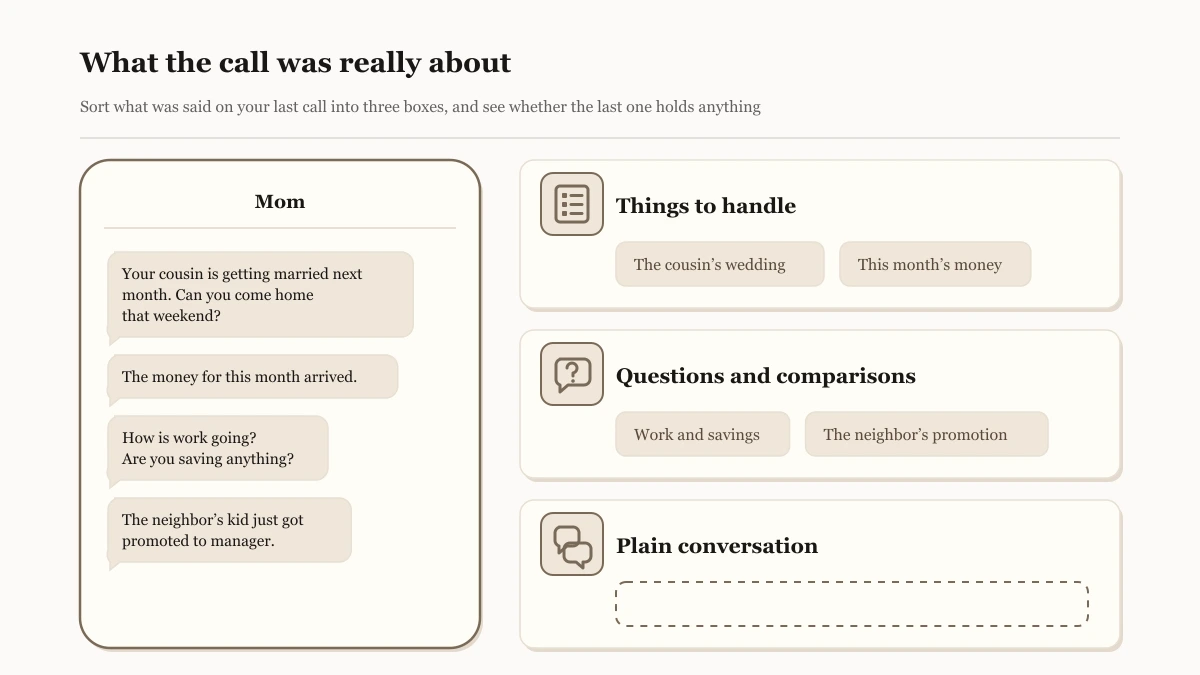
If the last box stays empty, you can see exactly where your dislike comes from. For years, every contact with your parents has left you with something to handle, a question to answer, or another round of being compared with someone else. A call goes that way, and so does a visit. After enough of them, the moment you see their name you think of what you will have to deal with next and what you will be asked this time, which is why you sigh before you pick up and feel tired before you have even left for a visit. In my view, what you dislike is mostly this way of being together, made only of tasks and questions, and not necessarily your parents as people. The easy, relaxed time that makes liking someone possible has been missing between you for a long while.
So you do not have to force yourself to like them. Liking is a feeling, and you cannot order it to show up. What you do for them, though, has always been yours to decide.
What to do: you can do your part without liking them
The things you already do count, and they do not have to wait for the day you like your parents.
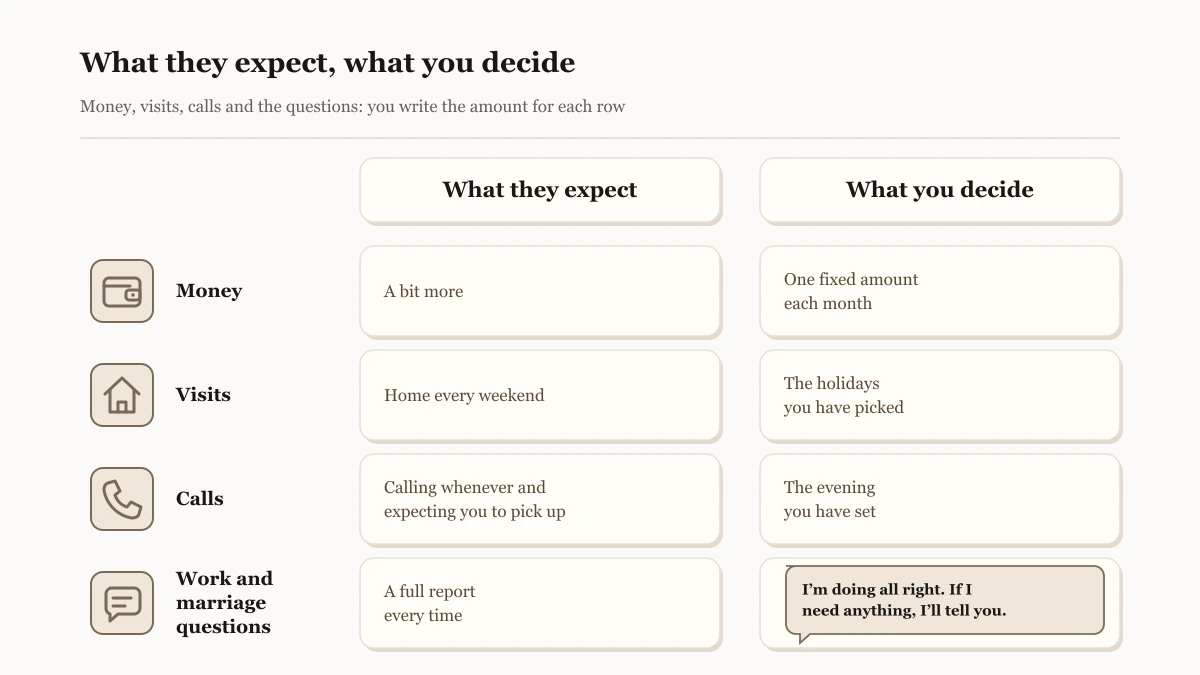
First, write down the few things you have decided to do. Make each one concrete enough that you will know when it is done: which day of the month you send money, how often you call, which holidays you go home, which kinds of help you will give when something comes up at home. You set the amount, based on your time, your energy and how far you believe you should go, not on whose expectations are loudest. Then follow the list. When one item is done, it is done. You do not need to add extra to make up for not liking them, and you do not need to demand that you enjoy it while you do it. I suggest writing it down because an unwritten duty has no end point, so you never know when you have done enough. Once it is on paper, everything you have done is visible.
Second, for the pressure, keep one reply ready. When they ask how work is going, how much you make, when you are getting married, or compare you with someone else’s child, you do not have to explain from scratch or try to convince them. Pick one sentence and use it every time: “I’m doing all right. If I need anything, I’ll tell you.” Then change the subject, or say you need to get going. If you mostly talk by phone or message, typing it works the same way. Because it is always the same sentence, you no longer have to work out each time how to account for your life. Both of these are in your hands: you write the list, and you choose what to say when the questions come.
Four things you will probably ask next
My parents ask, “Don’t you like coming home?” What do I say?
Tell the truth, but about what happens when you are together, not about how you feel toward them. You could say: “Coming home is tiring sometimes, because I get asked about a lot of things every time. I’ll keep coming back. I’d just like it to be more relaxed.” I suggest it because it is honest without turning your dislike into an accusation, and it describes something that really does happen between you.
I live with my parents and see them every day. What then?
Start the same way, by writing down what you have decided to do, because people who live with their parents need that list even more. Household tasks keep arriving one after another, and it is easy to take on all of them until none of your time is left. Write out the ones that are yours: which days you cook, which chores you handle, how household costs are split. For anything outside the list, you can say, “I can’t do that one today.” Once your items are done, the rest of your time can run at your own pace, without the feeling that you owe anyone.
What if my parents don’t seem to like me much either?
That may be so. My guess is that if all that is left between you is business, the same is true from their side: when they see you, your job, your income and your marriage are the only questions they can think of. Whether they like you is not something you can decide for them. What you can decide is which things you do, and how you see yourself. The next time something they say makes you feel you are not good enough, tell yourself quietly: “I did what I decided to do.”
Will I regret not liking them someday?
In my judgment, what hurts when people look back is usually the things they had decided to do and never did, less often whether they liked someone at the time. So the way to have fewer regrets later is to do the things on your list, not to force yourself to like them now. If there is something you worry you would not be able to let go of later, add it to the list now: it might be remembering their birthdays, or helping them finish some paperwork they have been meaning to sort out.
Everything you give is something you chose
My view is that you came to dislike your parents because, over these years, all you could say to each other was what needed doing and what needed reporting, and liking never had room to grow. Wanting to do right by them without forcing yourself is a reasonable thing to want, and the change is only one: stop pushing yourself to like them, do the things you have decided to do, and use that one sentence when the questions come.
After that, you set how much you do, and once it is done you can put it down. Liking may come back a little one day, or it may not. Either way, you no longer have to carry out your duties while blaming yourself for not being good enough, and as I see it, that is already far lighter than how things are now.
You have given what you are able to give. Someone who can dislike their parents and still choose to give all of that has a soft heart, and always has.
Sources
Research and sources this essay draws on.
- The Best of Ties, the Worst of Ties: Close, Problematic, and Ambivalent Social RelationshipsJournal of Marriage and Family, 66(3), 792–808