Why Does Your Child Always Read the Room? The Invisible Wound Left by a Home Where Moods Come Without Warning
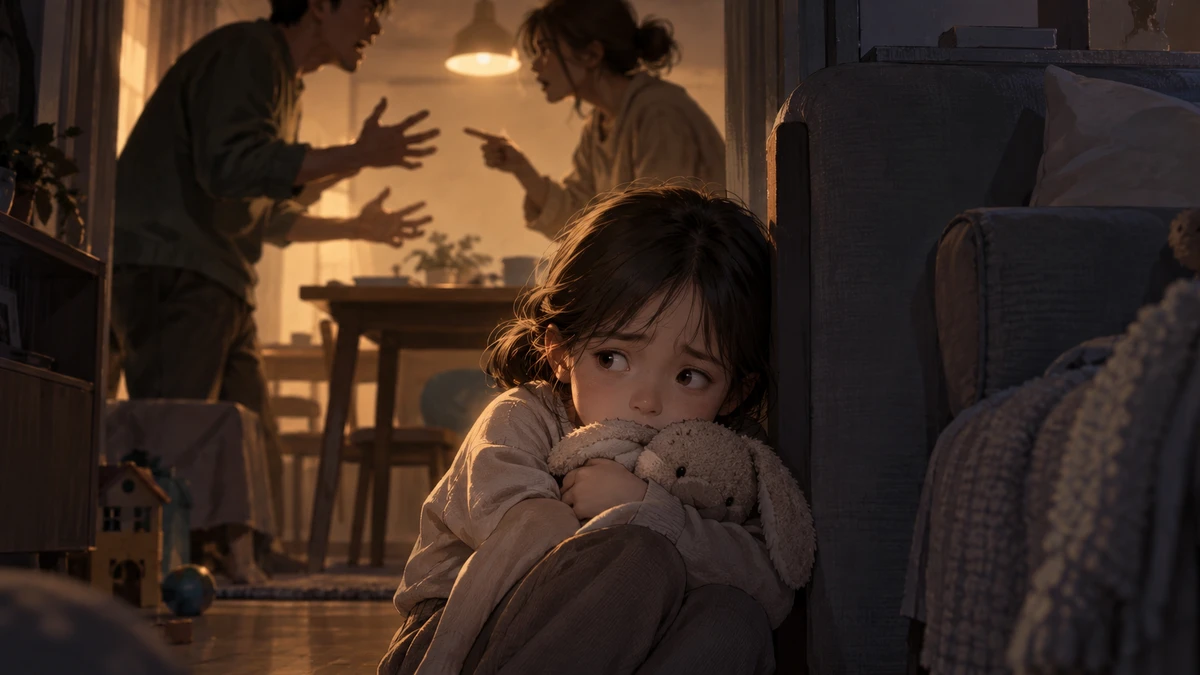
Ten minutes ago you were yelling. It was something small, the kind of thing that looks small as soon as it is over: homework not done, dishes left out, the tone they used when they answered you. Now you are fine. You come out of the room and they are sitting in the corner of the living room, quiet, well behaved. You call them to dinner. They look at your face first, and only then do they say okay.
Somewhere in there you notice two things. You cannot remember the last time they answered you without checking first. And lately they can tell you are in a bad mood from your footsteps and your face; you are barely through the door and they have already worked it out.
There is a sentence you have probably not said to anyone, because saying it means admitting something: “Did I do this to them?” And a quieter one right behind it: “I don’t want to be like this. How do I change?”
I am not going to walk you through what you did wrong. I want to look at what your child is actually doing in the minutes before and after you lose your temper, and at three sentences that can put that right.
You noticed the look. That is the first step, and you learned this too.
Plenty of parents go a whole life without noticing that their child checks their face before speaking. You noticed. That is where change starts, and it is what makes the rest of this piece usable.
Your temper has a history. Maybe work is squeezing you and one small thing at home lights the fuse. Maybe you grew up in a house like this and the moment you open your mouth you hear your own parents coming out of it. Maybe you are just tired, too tired to say things well. All of that is real, and none of it has anything to do with how much you love this child. You probably love them more than anyone.
Let me set the edges. Whether you are a good parent is not something this piece decides. Never getting angry again is not something this piece asks. It covers one thing: what your child is doing around your bad moods, and three sentences that can change it. You can start saying them tonight.
Here is how I see the reading itself: a child does not come out fast at reading faces. They get fast by practice, and the earlier and the more they practice, the faster they get. A child facing a parent in a bad mood has almost nothing to work with. They cannot make you calm down. They cannot leave. They cannot say “I’ll step out for a bit,” and they certainly cannot say “you’re scaring me.” The one thing left is to know early. Know one minute earlier what mood you are in tonight, and they get one minute to tuck themselves away, hold the thing they wanted to say, take the homework to their room.
They practice that a few thousand evenings in a row. Every footstep, every closing door, every dinner where the table goes suddenly quiet is another rep. After a while, even you start to believe it is personality, that they were simply born easy, born mature. I would say no. That is a way of staying safe that a child worked out for a house where moods came without warning.
The things you have not said out loud
Below are the sentences I imagine come to you when you are alone.
“I had it much worse as a kid. I’m already doing far better than my parents did.”
The way I see it, that is true, and it means you have already done a lot; you have stopped a great deal of the last generation at your own front door. The trouble is that your child has no such comparison. They never saw the house you grew up in. They only see you. To them, your moods are the whole of what they have to deal with.
“I don’t want to be like this. I’m just under so much pressure.”
The pressure is real and so is the tiredness; I would not take a cent off either. You are allowed to be under pressure. You are even allowed to lose your temper while you are under it. Not one of the three sentences coming up asks you to solve the pressure first. They only ask that, when the pressure is high, you say one sentence to your child so they know your bad mood is not something they caused.
“They’re fine. They’re such a good kid.”
They are. What I would ask you to look at is when the good started. A child who suddenly becomes easy has usually not grown up; they have worked out that easy is safer, that quiet gets noticed less. They have not told you they are unhappy because they have already learned not to tell.
“Once I’ve calmed down they’re fine. Kids forget.”
Here is how I read it: they forget the incident. What it was about, what you said, they may genuinely not remember. What they keep is something else: next time, before saying anything, check your face and work out whether you are in a mood to hear them. Checking your face first is the one thing they will not forget, because it has saved them from a great many scoldings.
“I’m not going to apologize to my kid. A parent doesn’t do that.”
Let me answer this one directly: none of the three sentences in this piece is an apology. They are an account, a word about what just happened and whether it had anything to do with them. A parent who gives an account does not shrink in a child’s eyes. They become predictable, and a predictable parent is the one a child dares to come near.
What these sentences have in common, as I read them, is that each one is a reason not to change. And since you have read this far, those reasons are probably no longer enough to hold back the part of you that wants to change.
Getting angry is not the problem. No warning and no account afterward is.
First, something I want to be plain about. You are allowed to get angry. A house is allowed to have feelings in it. A parent who loses their temper is not, by itself, an emotional home. I have my own bad days, days when my sentences get short, and that is not hurting anyone. People have those days.
An emotional home is a different thing. It is a house where moods arrive with no warning, no reason, and no account afterward. The child never knows when it is coming; the same thing is fine on Monday and sets you off on Tuesday. When it comes they do not know why; they run through everything they did that day and cannot find the one that caused it. When it passes, nobody says “that wasn’t about you.” Breakfast happens as usual, as if nothing occurred, and they are the only one who remembers.
I have long believed the wound in a house like that is not the shouting. Shouting passes. One frightening night passes. What stays is having to guess every single time: what kind of day is it, was that line aimed at me, is it safe to speak. The child paid for wrong guesses, so they practiced until the guesses stopped being wrong, until one step through the door was enough.
I want to give you a picture. You do not need to ask them; look once and you will know. The second your child gets home, what do they do first: put down the bag, or check your face?
If your child is grown and living elsewhere, listen to the first thing they say when they call: do they start with their own news, or do they ask how your day was?
So why does a child always read the room? My answer: because it was the only thing in that house that worked. They could not change your mood. The one thing they could do was judge it early, so they made judging your mood their job. They did it well. They did it so well that eventually nobody remembered it was never supposed to be their job, you included.
Why the wound is invisible, and what it grows into
It hides because it looks like a strength. Easy, mature, considerate, never any trouble: every one of those is a word you would use to praise them to a relative, and every one is a word a teacher writes in the report. Nobody calls a strength a wound, you included. So it gets praised, all the way to adulthood.
What it grows into, I would put like this: they will grow up knowing everyone’s mood, and nobody will know theirs, not even them.
They will walk into any room and check who is in a bad mood before they decide what to say, or whether to say anything. When someone asks “are you okay?” they will check that person’s face first, to see whether it is a real question, and only then answer “I’m fine.” Their own mood will sit at the back of every line, and by the time it is their turn, they will not be able to find it. People will praise them for it into their thirties, call them thoughtful, easy to be around, and they will believe it is personality.
That house taught them this. They did not choose it. And here is the part I most want you to hear: it is not too late. They are still waiting for you to say “that wasn’t about you,” and as long as they are still waiting for that sentence, there is time.
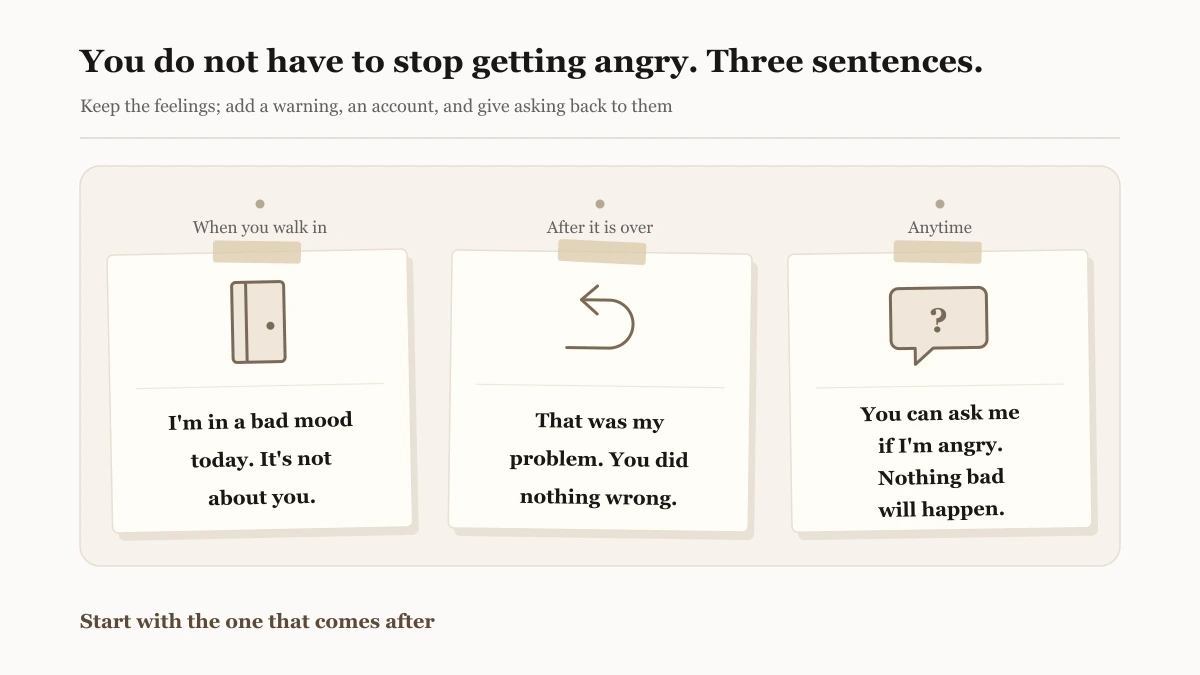
You do not have to stop getting angry. You need three sentences.
I would not start with “I’ll never get angry again.” That road is too long; you will give up before you reach the end of it. What I want to give you is three sentences. They do not ask you to change the feeling. They add a warning and an account, and they hand one thing back to your child.
The sentence before: “I’m in a bad mood today. It’s not about you.” Say it when you walk in, or when you notice you are close to the edge. After you say it you are still allowed to be in a bad mood, allowed to be short, allowed to go to bed early. The difference is that they do not have to guess. They know what kind of night it is and they know they did not cause it, and with those two things known, they can get on with their own evening.
The sentence after: “That was my problem. You did nothing wrong.” Say it once you have calmed down. No explanation of why you shouted, no promise it will never happen again, no going back over the thing itself; one account is enough. This sentence does exactly one job: it lets them out of the question “was it me?” If it only occurs to you days later, saying it late still counts. Saying it over breakfast the next morning counts.
The sentence you give back: “You can ask me if I’m angry. Nothing bad will happen.” This one returns asking to them. They stopped asking because asking made it worse; “are you angry?” used to earn “what do you think?” You are changing that now, so that asking gets them an answer instead of another outburst. My judgment is that every time they ask and get an answer, they need guessing a little less to stay safe.
You do not have to do all three at once. I would begin with the sentence after; it is the easiest, because by the time you say it you are already fine. On the days you cannot manage it, the next morning still counts. What your child needs is not that you get it right in the moment. It is that you come back. If your child is grown and living elsewhere, the three sentences work over the phone. Call and say “that call the other day, that was my problem, not you,” and leave it there. What matters is not how they answer; it is that the sentence finally got said.
If you are the child who grew up
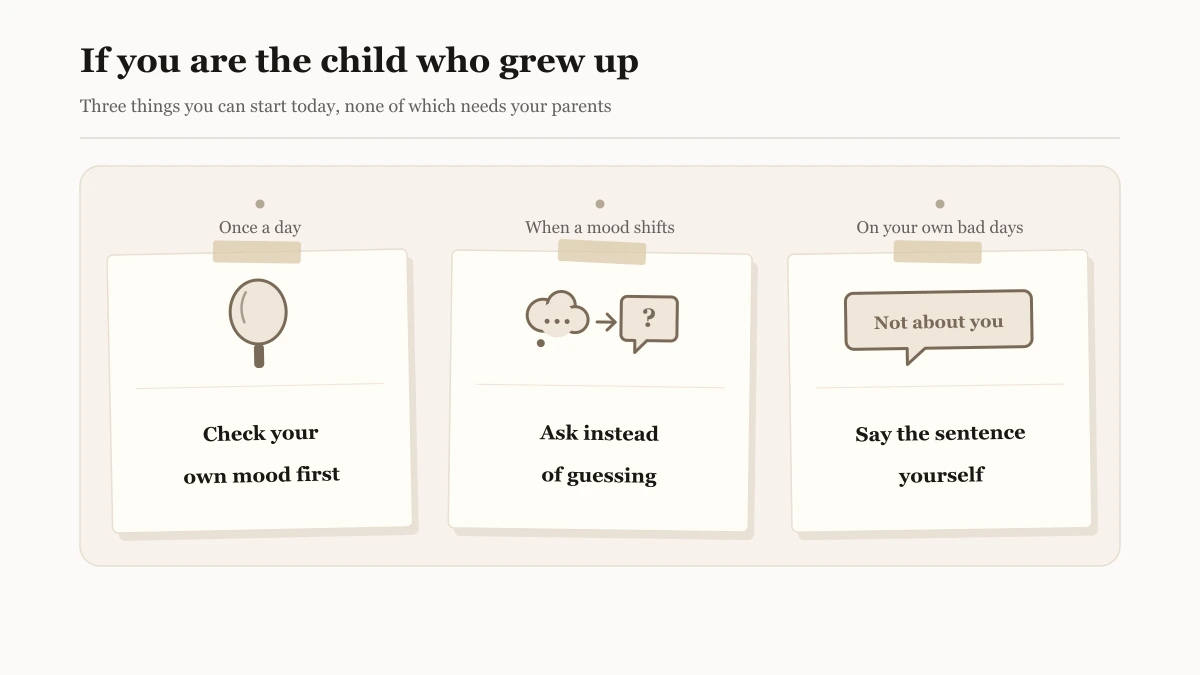
Maybe you did not open this as a parent. Maybe you are the child, grown now, and you still walk into every room and check who is in a bad mood first. People call you thoughtful. Only you know how tired you are after an hour with other people. You probably recognized everything above before any parent would. This section is for you: three things you can start today, none of which needs your parents to take part.
Check your own mood first
Once a day, before you check anyone else’s face, ask yourself. Before you leave in the morning, or before you walk into any room, answer one question in your head, “what am I feeling right now,” with a single word. Tired, flat, fine, a bit irritated, anything. Do not write it down, do not tell anyone, do not act on it. It does one thing: it adds you to the people whose mood you pay attention to. You have watched everyone else’s mood for years, and the one person you never checked on was yourself. Starting today, add yourself.
Ask instead of guess
The next time you notice someone’s mood shift, do not guess. Ask one thing: “You look a bit tired. Want me to come back to this later?” Then wait for the answer, and any answer is fine. If it is “it’s not about you,” let it go, actually let it go, no going back over the day. This is the whole point: as a child you could not ask, because asking made it worse, so guessing was all you had. Now you can ask. That is the biggest difference between then and now. The way I see it, the people in front of you now are able to answer, and once you have asked, the matter can stop at their answer instead of running for three days in your head.
Say the sentence yourself
The sentence this piece asks parents to say, “I’m in a bad mood today, it’s not about you,” is the one you most needed to hear as a child and nobody said. You can say it now, on your own bad days, to whoever is next to you: a partner, a friend, someday a child. Someone who says that sentence is already different from that house.
If your parents are old now and much calmer, here is how I see it: the wound was left back then, and how they are now is a separate thing; both can be true at once, and you do not have to decide first whether to forgive or to hold it against them. As for how far away to live from them now and how often to go back, that is a different subject, and I covered it in Not Every Family Feels Safe: How Much Distance Is Right for You?.
A home can have anger in it, as long as someone says so first
If you are the parent, here is the last thing I want to say: you do not have to become someone who never gets angry; your child was never waiting for that. They are waiting for you to come back and say a word: that today was not about them, that what just happened was yours, that they are allowed to ask. You can say the first one tonight. Saying it badly counts. Saying it late counts.
If you are the child who grew up, here is the last thing I want to say: reading people is something you learned in that house, and it carried you through those years; from today it can be used to look after you. Add yourself to the people whose mood you check, put a question in place of a guess, and then say the sentence to the next person.
Here is how I see the whole of it. The difference between an emotional home and a home with feelings in it was never whether anyone loses their temper. It is whether anyone says so before it happens and gives an account after it passes. A home can have anger in it, as long as someone says so first. From today, that someone can be you.