Why Do We Hurt the Family We Love Most With Our Words?

At work, you can say, “Sorry to bother you — could you take another look?” At home, the same frustration comes out as, “How many times do I have to tell you?” The moment the words land, you see the other person’s face change. You regret it almost immediately. You love this person. Why, then, do they receive the least patient and most cutting version of you?
Do not rush to sentence yourself as a terrible son, daughter, sibling, parent, or partner. One bad sentence does not erase every act of love. The reverse is also true: love cannot erase the impact of a bad sentence. Research in which people recalled episodes of hurt found that emotional pain often came with a sense of relational devaluation — a feeling that the other person did not value us or the relationship as much as we thought. The people doing the hurting were usually familiar and important, not strangers. A family member’s words have power partly because the relationship has weight.
So the answer is not that greater love inevitably produces greater cruelty. Nor can the whole question be closed with a reassuring line about feeling “safe enough to let your guard down.” A more honest answer has several parts. Closeness creates more contact and interdependence. It raises the hope that this person, of all people, should understand. Shared history lets an ordinary sentence carry the weight of older roles and older fights. Those conditions can make escalation easier. None of them makes harm natural, necessary, or excusable.
Being polite outside and impatient at home is not merely a character flaw
With a stranger or colleague, the boundary is obvious. You do not know what they will tolerate. You know that rudeness may carry an immediate cost. You edit your meaning before you speak.
Family boundaries can become less visible. You share a home, money, schedules, care work, holidays, and memories. You know one another’s habits. You also assume that after a fight, you will probably see each other again tomorrow.
That does not mean people automatically lose self-control at home. It means home contains more points of friction with more meaning attached to them. Dishes, arrival times, unanswered messages, or a changed plan may look small from outside. Inside the relationship, they may be connected to fairness, respect, autonomy, attention, and whose exhaustion counts. You say, “Why is the trash still here?” They hear, “You are never dependable.” They answer, “Can’t it wait?” You hear, “Your workload does not matter.”
Work on intimacy offers another clue. Across everyday interactions, disclosure was connected with closeness partly when the listener’s response felt understanding, validating, and caring. At home, the real injury may not be that your family member disagreed. It may be that the person you expected to see you did not notice that you were at your limit.
The higher the expectation, the more weight the gap can carry. That is not a demand for mind reading. It simply helps explain why a fight that appears to be about one chore often contains an unspoken sentence: How could you not see me?
Why can one sentence from family stay with us for years?
Because a family member is not only a speaker. They may also be one of the people whose response helps you decide whether you are valued and whether you belong.
Studies of hurtful messages found that a comment was more distancing when the recipient perceived it as intentional or as part of a repeated pattern. A separate survey focused on family communication found that hurt often pulled people toward two broad reactions: aggressive engagement or an indirect retreat. In other words, the sentence does not only create pain in the current moment. It shapes the posture with which the next moment begins.
That is why “I was just saying it” rarely retrieves the damage. Intent matters, but impact does not disappear. If “You’re useless” has appeared for years, today’s listener does not hear only today. They may hear every comparison, joke, interruption, and failed attempt to explain themselves stacked underneath it.
I would not label every such memory trauma, and I would not diagnose an entire family from one exchange. I would ask three more practical questions. Was this an isolated failure or a recurring pattern? When the impact is named, does the speaker become curious about it? Next time, is there a visible change?
The most dangerous part of a fight is how quickly it becomes a loop
Many family arguments do not begin with one person pressing a clearly marked villain button. They become a loop. One person feels ignored and raises the pressure. The other feels attacked and defends, shuts down, or leaves. The first person reads the retreat as indifference and pursues harder. The second feels even more desperate to escape. Soon both people are responding to the other person’s last defense. Nobody is talking about the original problem.
Observational work with parents and adolescents captured this moment-by-moment reciprocity of negative emotion. When one negative response was followed by another, conflicts tended to last longer and felt less resolved. This evidence reminds us that a conflict has both a beginning and a sequence, and what each person passes into the next turn matters.
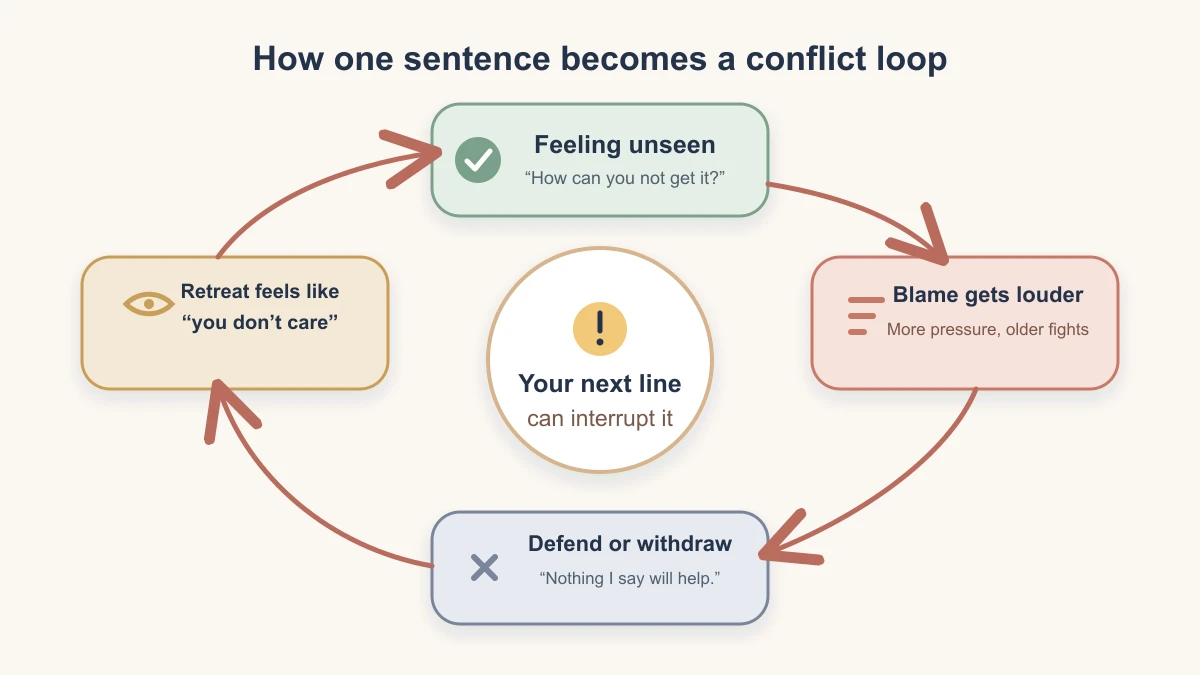
Seeing a loop does not mean dividing responsibility equally. If someone threatens, humiliates, controls, or uses violence, “both people were emotional” does not turn responsibility into a fifty-fifty calculation. The value of seeing the loop is that, in an ordinary conflict, it reveals a place where one person can stop feeding it. I may not control the next thing my relative says. I do not have to hand my next sentence to momentum.
A pause is not the silent treatment if it protects a return
When emotion rises, the only options can appear to be explosion or suppression. But hiding every sign of emotion while continuing to boil inside is not the same as regulating it.
I suggest turning “walking out” into a pause that is explained, time-limited, and connected to a return:
I’m getting too activated, and I can hear myself reaching for something cruel. I don’t want to speak to you that way. I’m taking twenty minutes. I will come back at nine, and we will talk only about what happened tonight.
If you honestly do not know how much time you need, try this:
I can’t listen well right now, but I’m not disappearing. Before bed, I will tell you when I can continue this conversation.
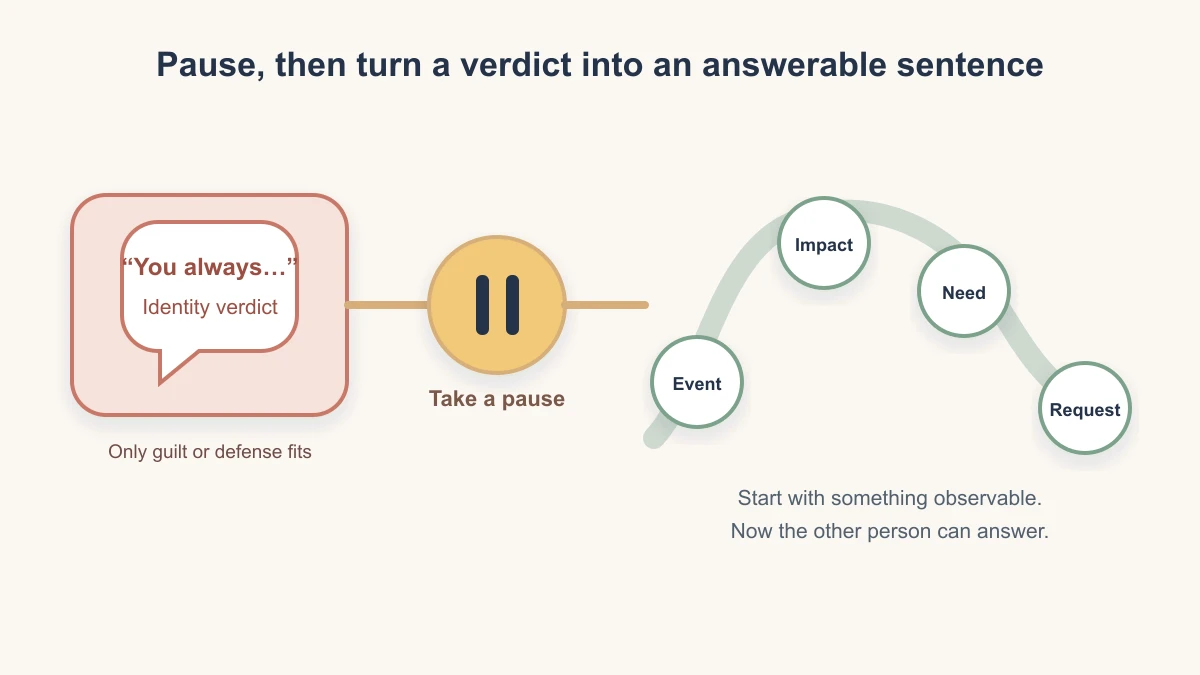
During the pause, do not draft a more devastating prosecution. Drink water. Walk around the block. Once the emotional pressure drops a little, separate the verdict in your mind from what you actually observed.
Divide what you want to say into two columns. On the left, write “My verdict about them.” On the right, write “What I actually observed.” For example, the left may say, “She has no respect for me,” while the right says only, “While I was speaking, she looked at her phone and did not respond.” The right-hand column gives you material for restarting the conversation.
Replace a verdict with an event your family member can answer
Cruel sentences often share one feature: they do not describe what happened. They announce what kind of person the other person is.
“You never help” compresses years into an absolute judgment. “You are selfish” turns a choice into an identity. “I knew you would do this” sentences today to repeat yesterday. The listener has only two roles available: plead guilty or fight the charge.
I prefer a sequence that is less elegant but more answerable: the specific event, its effect on me, what I need now, and one observable request.
Instead of:
You treat this place like a hotel. You never lift a finger.
Try:
The dinner dishes were left overnight three times this week, and I had to get up earlier to clear them. Can you wash them before you rest tonight? If that does not work, let’s divide the job again now.
Instead of:
You care only about yourself. Family means nothing to you.
Try:
Yesterday you canceled after I had arrived, and I waited alone at the restaurant. That hurt. Next time a plan changes, I need you to message me as soon as you know.
This format does not guarantee cooperation. Its value is that it names what you actually need. It also gives you clearer information. Is the other person responding to a concrete request, or evading any form of accountability?
If the words have already hurt, how do you apologize without demanding closure?
An apology often collapses when “I’m sorry” is immediately followed by a bid to reclaim innocence: but you were awful too; but I was exhausted; but I did not mean it. That background may deserve a later conversation. It cannot do the work of accountability while also diluting it.
Experiments that tested different components of apologies after designed trust violations found that acknowledging responsibility and offering repair were more persuasive than merely requesting forgiveness. The scenarios were not long family relationships, so I would not turn the result into a formula that promises reconciliation. It offers a useful check: is my apology attending to what the other person carries, or trying to make them remove my guilt?
A complete apology can still sound like a human being:
I called you useless. That attacked you instead of addressing the problem. It was wrong, and I can see how it would make you feel that I look down on you. I’m not taking back your reaction; I’m taking responsibility for my words. I will say what I meant again without a label. Next time I feel a label coming, I will pause. If you do not want to keep talking now, I respect that.
Then make the change visible. Stop next time. Return when you said you would. Retire the familiar insult instead of finding a softer version of it. An apology may open a door to repair. It cannot order the injured person to walk through. They may need time. They may decide that the old degree of closeness is no longer available. “I apologized” does not cancel that choice.
If you are always the only one repairing, a boundary is not a failure to love
Some conflicts involve two people who are willing to learn how to speak more clearly. Other relationships involve recurring humiliation, threats, control, or violence followed by a demand to stay because “we are family” or “I only do this for your own good.” These situations do not call for the same communication exercise.
A boundary is not “I will make you suffer.” It is “When this happens, here is what I will do to protect myself.” For example:
You may disagree with me. If you insult or threaten me, I will end the call. We can try again when we can speak without personal attacks.
Then end the call if the attack continues. Do not spend another hour proving that your boundary is reasonable to someone actively trampling it. If leaving a room may make the situation more dangerous, tell a trusted person what is happening, identify a safe place you can reach, and contact appropriate professional support or emergency services where you live.
If you are trying to decide whether this was one loss of control or a relationship that continually consumes you, continue with How to Leave a Relationship That Keeps Draining You. You do not have to prove that the other person has never loved you before you are allowed to stop absorbing harm.
Three questions you may still be asking
If I do not settle it immediately, am I avoiding the problem?
If you disappear without explanation and never return, the other person may understandably experience it as the silent treatment. A pause is different because it has a purpose and a next point of contact. When you return, do not pretend nothing happened. Narrow the scope and discuss that event. If you postpone every time, it is no longer a pause. It is avoidance, and you need to be honest about your unwillingness or inability to engage.
My family says, “The words are sharp, but the heart is soft.” Should intention be enough?
Intention can help explain where a sentence came from. It cannot erase where the sentence landed. Care that can sustain a relationship must make room for “That hurts me” and for an adjustment in behavior. Asking you to appreciate the soft heart while continuing to swallow the blade is not repair.
I am so afraid of hurting them again. Should I stop saying anything difficult?
You do not have to tie honesty to injury. You may be angry, disappointed, or unwilling. You may tell family how a decision affects you. What you can release is mind reading, contempt, humiliation, and identity verdicts. Replace “This is who you are” with “This is what happened, this is how it affects me, and this is what I will do next.” You remain honest. You stop using honesty as a weapon.
Love is not never getting a sentence wrong. It is refusing to let harm keep traveling
We are easy to wound with family words because those voices already carry weight. We may also reserve our sharpest voice for family not because we love them less, but because expectation, fatigue, shared history, and the next defensive turn all gather at the same table.
An explanation is not a destiny. You can place a pause before the sentence leaves. When you get it wrong, you can repair without purchasing quick forgiveness with an excuse. When another person refuses to stop hurting you, you can remove yourself from the exchange.
A home does not have to be the place where anything can be said and nothing counts afterward. It can be the place where we are honest and take the greatest care with our impact. If you can do only one thing today, choose one verdict you often throw at family, such as “You are selfish” or “You never think about anyone else.” Rewrite it as an event that happened, a real effect, and a request the other person can understand. It cannot promise an immediate reconciliation. It is still a worthy place for the next turn to begin.