They Were a Different Person While They Were Chasing Me. Was Any of It Real?
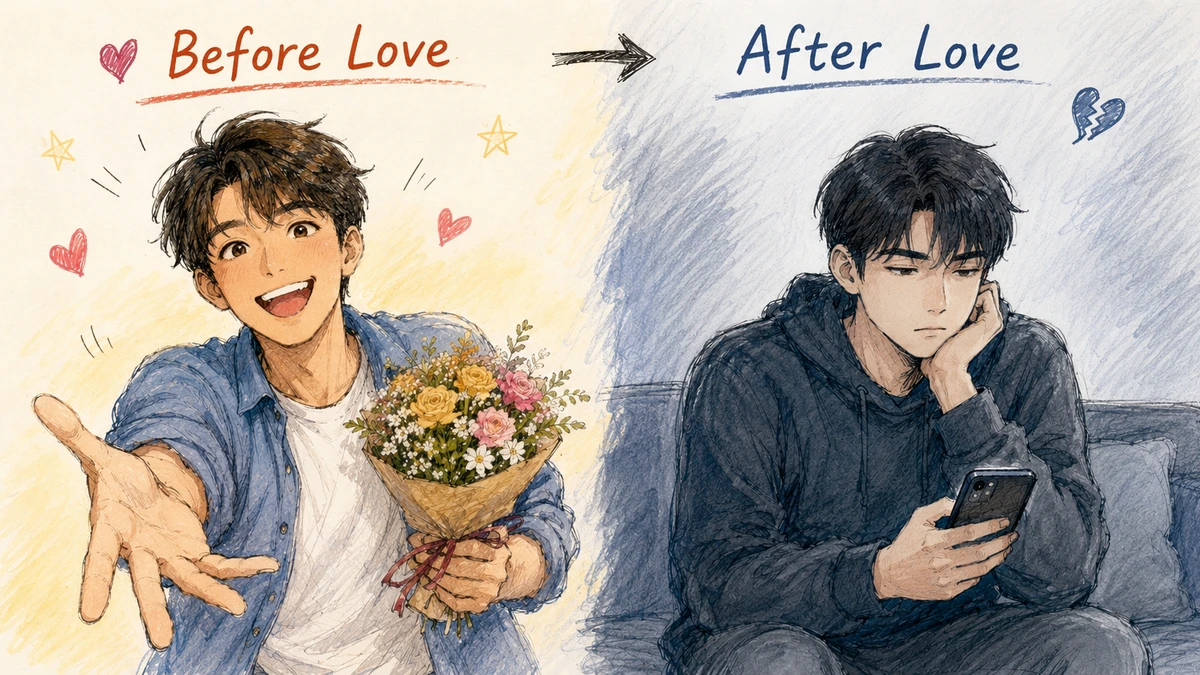
They are on the other end of the sofa, scrolling. You are on this end, thinking about one thing: when was the last time they messaged you first, just to ask what you were doing.
You think about when they were chasing you. Back then they drove an hour to pick you up so the two of you could have a forty minute dinner. You mentioned one restaurant, once, and three months later they took you there. On your birthday they had the whole route planned, including what to do if it rained.
Now you ask what they want for dinner and they say anything is fine.
Or maybe that is not it. Maybe you have been together three years and you stopped asking a long time ago. It is just that today someone brought up how the two of you got together, and you told the story and laughed, and then went quiet for most of the drive home.
And then the sentence arrives.
Was any of that real, or were they just performing?
If that is the sentence that brought you here, let me say what this piece is for. It will not decide for you whether they still love you, and it is not a guide to making them chase you again. I want to help you separate two things that keep getting stitched together: the performance stopping, and the care stopping. The first one happens to a lot of people. The second one is the one to actually look at. They call for completely different responses.
The gap is real, and you have evidence
Let me start with this: the version of them you are comparing against actually existed.
You did not invent a better partner and pin it on them. You are not borrowing somebody else’s story. They really did those things, and you are remembering correctly. So the ache you feel now is there because you have evidence.
And the fact that this hurts at all means what you want is not company. You already have company. You want that person.
If you have been together a long time, you may not even bother saying you are upset any more. That does not mean you stopped caring. It usually means you said it once and nothing changed. Not saying it is not the same as letting it go. It is conserving effort.
What they want from you may have changed
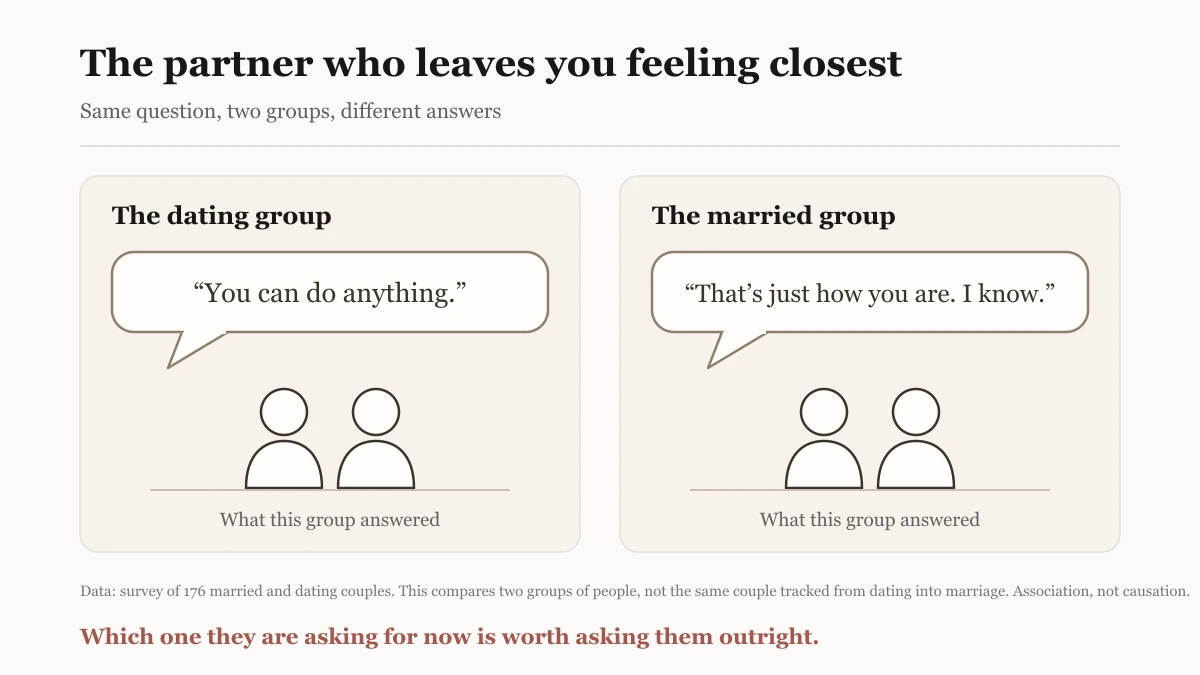
One study put two kinds of people side by side: couples who were dating, and people who were married. It asked them the same thing. What kind of partner leaves you feeling closest?
For the dating group, the answer was a partner who evaluated them favourably. For the married group, the answer changed: a partner who saw them the way they saw themselves. There was a result inside the married group that fewer people expect. Some of them did not think highly of themselves in the first place. They saw themselves as bad tempered, or as someone who puts things off. When those people had a spouse who saw them the same way, without dressing them up as better than they were, the intimacy they reported was higher. What made them feel close was not being told they were wonderful. It was being told, I know what you are like.
Let me block a misreading right away. This is not saying you should point out their flaws more often. My reading is that what they are asking you for shifted, from “like me” to “know me.” The first one asks for a performance. The second one asks for a person who can relax.
And relaxing, from the outside, looks a great deal like not caring.
That is the part I find most unfair about all of this. They finally stopped having to hold it up, and what you got to see was them putting it down.
“A different person” is actually three things
The first is that what stopped was expensive. A large share of courtship is built to be witnessed: flowers, planned itineraries, public posts, an hour of driving for a forty minute dinner. That costs a lot, far more than anyone’s ordinary rate. That speed exists for a particular stretch of time. It is not daily life. I would say that whether it stops and whether they love you are two different questions.
The second is that you moved from someone to be won to someone on the inside. The shift from “like me” to “know me” is what it looks like once it walks around in a normal week. They start wearing the terrible pyjamas in front of you. They tell you about the humiliating thing that happened at work. They let you see the part of them with a bad temper. They stopped curating, because they are no longer applying for the position.
This one gets misread the most, because it looks almost exactly like going cold. Same drop in conversation, same absence of plans. One is because you are on the inside now. The other is because they are on their way out.
And being treated as someone on the inside rarely arrives feeling like good news. They used to ask whether you wanted to have dinner together before they went out. Now they say “I’m going to my mum’s” and leave. They did not ask because they assume you will still be there. There is a very unromantic kind of trust in that sentence, and trust sometimes looks exactly that unimpressive.
The third is that they really are pulling back. It is not only the performance that stopped. The care stopped too. That one is not the same animal as the other two.
The first two are a gear change that happens to a lot of people. The third one is not. And telling which one you are in does not depend on how warm they seem.
One thing you can count tonight
Sort what they do into two piles.
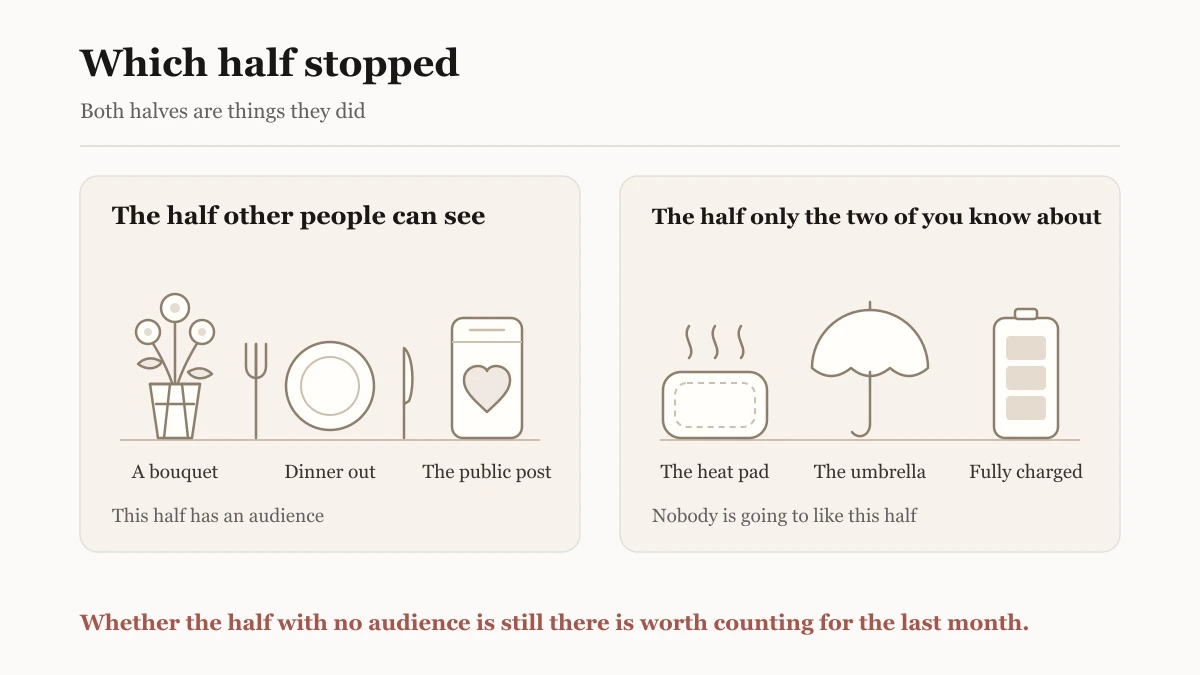
The first pile is the part other people can see: flowers, restaurants, anniversaries, public posts, a whole weekend cleared out. This pile has an audience, even if the audience is only your mutual friends.
The second pile is the part only the two of you know about. They took a detour to buy a heat pad on the day your cramps were bad. They are the one who remembers when your car is due for a service. You fell asleep on a late night call and they did not hang up. They took leave the week your mother was in hospital. Nobody is going to like any of that.
Here is how I would put it: the performance stopping and the care stopping are two different things. The first pile stops because it is expensive, and because it existed to make you see them, and once you have seen them its job is done. The second pile does not evaporate just because two people got comfortable. It runs without an audience, so when it stops, something usually has stopped.
Which means what you want to count is not how warm they are. It is whether they are still there in the places nobody is watching.
And I suspect some people will get a surprise doing this, because the second pile has grown since the chasing days. It just never gets photographed and never gets retold, so it never gets remembered. You remember the bouquet. You do not remember that they cleaned your shoes yesterday.
There is also the reverse case, and I think it deserves saying out loud: the first pile is intact and the second pile is empty. Anniversaries always happen, the posts always go up, the photos look wonderful, and the night your fever hit thirty nine you called your own taxi. That combination is the one where everyone outside says they treat you so well, and once that sentence is out, the person inside it usually stops trying to explain. My judgement is that if only the pile with an audience is left, what you are looking at is nothing like the case where the performance stopped but the care did not, and what you are asking for is not a lot.
Four things you can do that need no agreement from them
First, count the second pile, and count the last month of it. Do not count the version in your memory, because memory keeps the photogenic parts. Even if you are long distance and see each other once a month, this pile is still countable. Do they know which day your interview is? You said you felt rough yesterday. Did they ask today? That thing that has been bothering you, did they come back to it?
Second, turn “you have changed” into something that can be said yes to. If you want flowers, say you want flowers. If you want one evening a week where neither of you touches a phone, name the evening. Nobody can catch “you have changed,” because it does not contain a single thing a person could go and do. A request with a date on it, one that can actually be finished, is something they can say yes to.
Third, sit with something uncomfortable first. Flowers you asked for do not feel the same as flowers they thought of. That difference is real, and I am not going to tell you it disappears once you speak up. For a lot of people the sticking point was never the flowers. It was that the bouquet was not their idea. So the question to answer first is this: if they can do it and just need you to say so, do you want to say so? Only you can answer that one.
Fourth, count your own half too. They were not the only one presenting a better edition during the chasing months. You did it as well. You changed your outfit one more time before you left, you filed the uglier moods away, you replied faster than you normally do. You came back down too. You just cannot see your own drop, because you are looking at yourself from the inside. I am not telling you not to be sad. I think that once you add your half to the ledger, the gap moves from “they lied to me” to “we both stopped holding it up,” and it is the second sentence that makes the days workable.
So was it an act?
I would say no, but the answer is only useful if I say what I mean by it.
Start with what an act would be. An act, to me, is when they already knew they could not keep it up, and those things were currency: currency for a yes, for a relationship, for you choosing them. Once it is bought, the whole lot gets withdrawn. That is an act.
And I do not think most people are doing that. When someone wants another person badly enough, my belief is that they briefly do become that version. For a while you take up most of the room in their head, so they can get up early, they can drive the hour, they can hold on to the name of a restaurant you mentioned once. I would not call that acting. To me it looks more like what a person looks like when their attention is parked on one thing.
So the real question is not whether they meant it at the time. It is what they did once they had it. Two people can both cool off: one withdraws the whole lot, including everything nobody else can see, and the other withdraws the staged parts but still turns up when you are ill. About the first, I would say yes, those things were currency. The second is not them deceiving you. It is them returning to their own stamina.
There is a third case, and I want to be honest about it. They meant it, but what they meant it about was winning you, not living with you. I would not call those people liars. The way I see it, they spent everything on the first half and never pictured the second. The way to tell, I think, is the same one: whether they show up for the second half.
Put plainly, I think the person who would drive an hour has not disappeared. They just no longer feel they have to prove it daily.
And here is the part I think helps most: whether it was an act matters less than you think. If they meant every second of it, that still does not make tonight easier. If half of it was aimed at winning you, that still does not make the years since then fake. What you actually make decisions on was never their old motive. It is whether they still do the things nobody else can see.
So what if you actually sort what they do into those two piles, count them, and the pile with no audience is empty?
That is an article’s worth on its own, and 5 Signs Someone Is Falling Out of Love With You is about exactly that; you can see your own count better than I can, so I am not going to hand down a verdict here.
The answer was never in the flowers
So why do some people change the moment they are actually with you?
If I only get one sentence, it is this: what was done to be seen will stop, and what was done for you will not.
The flowers, the planned route, the hour of driving: most of that was built to be witnessed, and its job was to get you to see them. You saw them, and you chose them, so that work is finished. And on their side, my reading is that what they were asking you for shifted too, from “like me” to “know me.” A person who is known does not have to perform, so they relaxed, and what you got to watch was them relaxing.
The things nobody else will ever hear about, knowing when your next appointment is, being there the night your fever spikes, were done for you from the start. They have no audience, so being chosen does not end them.
That is what sits underneath “a different person”: a performance that stopped, a request that changed, and someone genuinely pulling back. The first two are not the ones to worry about. The third is the one worth a second look, and what you are looking for was never in the flowers.
You might still be sad, and that is allowed. Sadness does not have to clear anything with anyone. But you will not trade a performance that ended for the sentence “you never loved me.”
And the person who would drive an hour, if they are still the one keeping track of when your next appointment is, has been here the whole time. And maybe this time it can be your turn to walk over.