My Friends Drifted Away After I Fell in Love. Is That Normal, or Did I Lose Myself?

Friday night. The group chat lights up: “usual place?”
You look at it for three seconds. You type “not this time,” and you turn your phone face down. Then it hits you: you cannot remember the last time you sat at that table with them. Nobody fought. Nobody wronged anybody. It is just that every time you were about to walk out the door, someone closer was waiting, and every time, you picked the closer one.
Maybe it was not the group chat. Maybe you were scrolling your contacts and stopped, because the list of people you could actually call is shorter than it used to be. Maybe a friend said, half joking, that you have gone soft in the head over this person. You laughed it off, and then thought about it the whole way home.
Is it normal for friends to fade after you fall in love? Or have I lost myself?
Here is what this piece is for. It is not here to hand down a verdict on you, and it is not a guide to running a better relationship. I want to help you separate two things that keep getting stitched together: your friends shrinking, and you shrinking. The first one happens to a lot of people. The second one is what people are actually pointing at when they say someone is lost in a relationship. They need completely different responses.
The person asking this has not thrown their friends away
I do not think someone who genuinely does not care about their friends looks this up on a Friday night.
The guilt you feel is real, and I think what it tells you is that those people still carry weight with you. It does not mean you did something wrong. The way I see it, a new close relationship rewrites your whole calendar, and nobody sends you a notice when it happens. The people who got moved down the list do not raise their hands and announce it either. So you usually find out all at once, much later, on some Friday night.
The friends who stopped inviting you are, I would say, probably not angry. After two or three declines, a friend quietly takes you off the “should I ask?” list. That is not a grudge. It is them trying not to put you in an awkward position. From the outside it looks like drifting. From the inside it is closer to politeness.
There were only ever a few seats that close
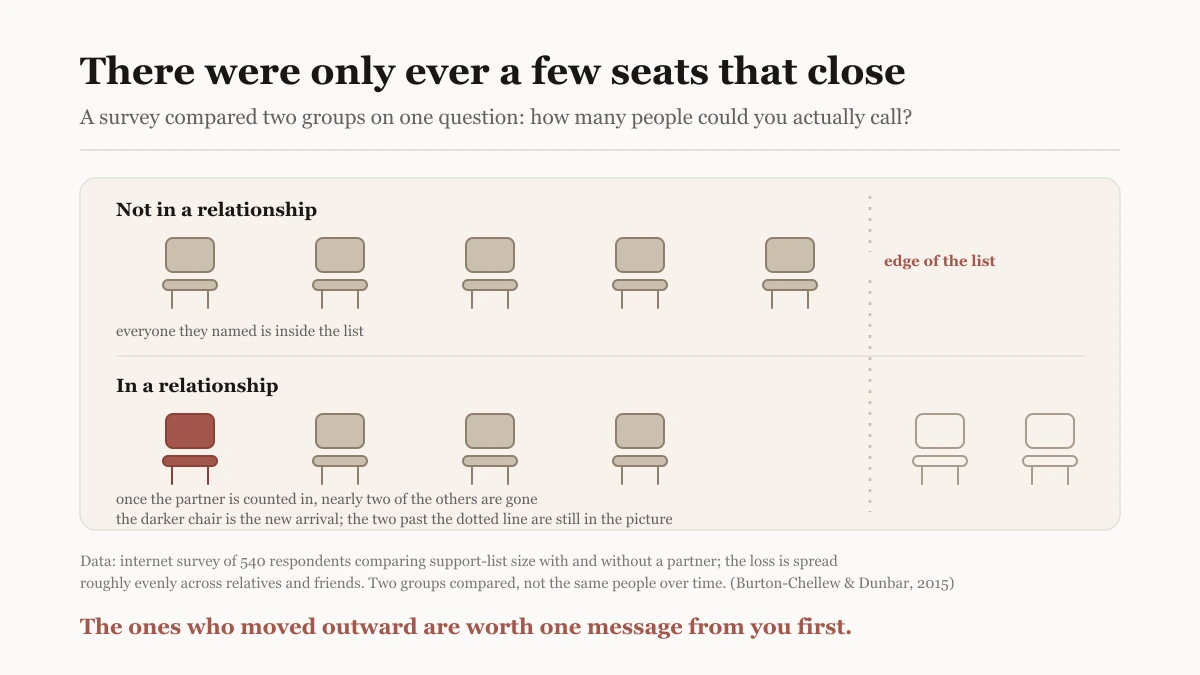
One study compared people who were in a relationship with people who were not, on a single question: when something actually goes wrong, how many people can you reach, and actually ask? People in a relationship named a shorter list. And it is not as simple as adding one name and moving on. Once the new partner is counted as an addition, the people who were already on that list came out nearly two fewer.
So what does that mean for you? My reading is this: it is not that you changed as a person. It is that there were only ever a few seats that close to you. When someone who takes up a lot of attention sits down, somebody gets shifted a seat outward.
And here is the distinction that matters most. Being shifted outward and being deleted are not the same thing. The people who moved out are usually still in the picture. They are just no longer the first name you think of when something happens. They did not leave. They only stopped raising their hand.
“Fewer friends” is actually three different situations
Pulled apart, this one sentence covers three very different things, and they are worth handling separately.
The first is a seat getting taken. The people are still there, just one place further out. Nothing broke. You went from once a week to once a season. This is also the easiest one to misread as “we are not close anymore.”
The second is you folding yourself in. You stop going out and stop replying, because you want to save the time for your partner. Or because every time a friend asks how things are going, you have to sort out your own feelings before you can answer, so eventually you stop bringing it up. You decided this one, which means you can also undo it.
The third is when you did not decide it. You explain where you are going, who with, what time you will be back, and then explain again when you get home. Nobody has forbidden anything out loud, but you have learned that declining is simply less trouble.
The first two I would call the normal reshuffling that happens to a lot of people. The third is a different thing. You do not have to work out who is right or wrong to tell them apart. You only have to ask one question: who decided that you would not go this time. If the answer has not been you for a long while, then the thing to look at is not your friend list. It is where that decision went.
What “lost in love” is really about: adding, or subtracting
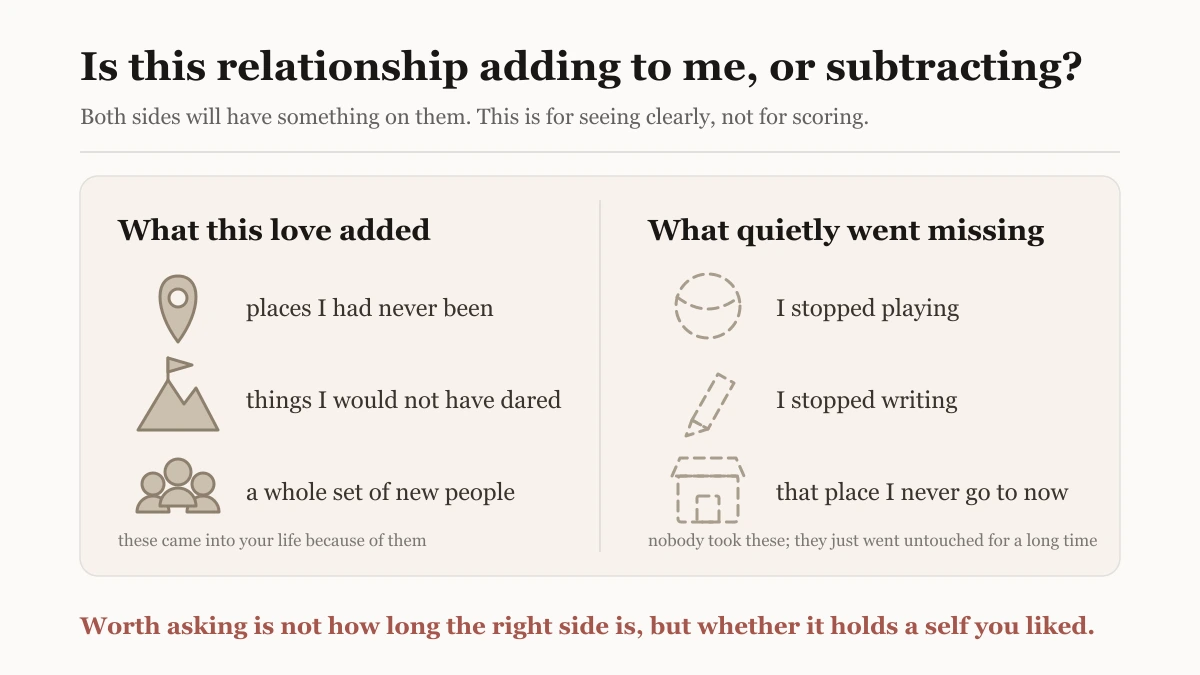
Here is how I read that phrase. The question is not how many hours you spend on your partner. The question is whether this relationship is adding to you or subtracting from you.
Adding looks like this: because of them, you have more, new places, things you would not have dared to do before, a whole set of people you would never have met, and often a slightly easier version of yourself.
Subtracting looks like this: the things you used to do go missing one at a time. You stopped playing. You stopped writing. That place you used to visit every month, you have not been in a long time. And the most telling part is that you cannot name the day it stopped.
What the data can say is that relationship-driven change in the self really does run in both directions, adding and subtracting, and that the adding side shows up alongside more love and better relationship quality. As for what “lost in love” is really pointing at, I think it is the subtracting half.
Not all subtracting is bad, either. Fewer all-nighters, one fewer punishing side project, one less person who leaves you feeling small every time. Those are subtractions too, and they make you more yourself. So the thing to watch is not how much is gone. It is whether what went missing was a part of yourself you actually liked. If a lot of what went missing turns out to be things you cut so your partner would feel secure, that is a separate thread, and I wrote about it in more detail in I Like You, but I Will Not Prove It by Abandoning Myself.
My read is that subtracting is rarely a decision. It is not a signature on some Tuesday afternoon. It accumulates, one “not this time” at a time. That is the bad news, because it is quiet enough to miss. It is also the good news, because anything built one piece at a time can be taken back one piece at a time.
So where is the line between being lost in love and loving well?
If you want one line you can actually say out loud, here is mine: the healthy version makes your world bigger, and the other one makes it smaller, and you cannot quite say who decided it should shrink.
The bigger version is easy to spot. They get to know your friends. You have been to the places they always go. The two sets of people start ending up at the same table. Your time really is taken up, but not by one person alone. The smaller version takes longer to see: there is less and less in your world besides each other, and the two of you never sat down and chose that. It went one concession at a time until this was all that was left.
There is a question you can ask today: can this relationship survive you having your own life? You see a friend, you do the thing you wanted to do, you come back, and the relationship is where you left it or a little better. That is the healthy version. If every outing costs you something on the way out and a bit of emotional cleanup on the way back, that cost is the thing worth looking at.
Deeper in, it comes down to whether you can still say what you want. Not what we want. Your half of it. If that sentence has not come out of your mouth in a long time, it is usually not because you became less selfish. It is because it slowly stopped having anywhere to go.
I would not treat any of this as a verdict. The first few months being all-consuming is not something I would worry about; relationships have seasons. What matters is where things stand half a year or a year in: whether your world has started growing back, whether you can say what you want again. If by then there is still nothing but each other, that is no longer a season.
You are not too late, and you do not need anyone’s cooperation
Three things you can do tonight, alone. None of them need your partner to agree, and none of them need a friend to reply first.
One: write down three things you stopped doing in the last six months, then circle the one you could do again this week. Do it because you want it, not to prove something or to reassure anybody.
Two: put your one or two most important friends in the calendar, instead of waiting for a free evening. Skip “how have you been” and ask “are you free on the ninth?” If they are in another time zone and meeting is not realistic, make the slot a voice message at a fixed time instead. It is not about being in the same room. It is about moving that person out of “sometime” and back onto a date.
Three: offer a true sentence instead of an apology. Not “sorry, I have been terrible lately,” but “I went all the way under for a while there. Are you still around?” I suggest it this way because an apology puts your friend to work reassuring you, and you both end up nowhere near the point. A true sentence gives them a chance to catch you, and I believe it is a chance they have been waiting for too.
The seat is still there, and you are still in time to sit back down
So, is it normal for friends to fade after you fall in love? Yes. Common enough that you do not owe anybody an apology for it. And where the line falls between being lost in love and loving well, I would say it is not about how many hours you spend on your partner. It is about whether this love adds to you or takes from you.
The way I see it, friendship is the only relationship where nobody comes to collect. Your partner will come and ask. Your family will. Work certainly will. Friends will not. They will just quietly take you off the list. That is why friendship always ends up last in line, and that is exactly why it is the one thing you have to put in the calendar yourself.
You do not have to win everyone back tonight, and you do not have to wait until you feel guilty enough to earn the right to come back. You only have to answer that message next Friday with “I’m in.”
The moment you sit back down, what comes back is more than one friend’s seat. The things you used to do, the things you used to say, the places you used to go, they come back with it. And I have always believed those things were never this relationship’s rival. They are the part of you they saw in the first place.